The rapid adoption of artificial intelligence (AI), Big Data analytics, and data-driven applications is transforming how organizations operate, innovate, and compete.
Data has become the foundation of modern business innovation.
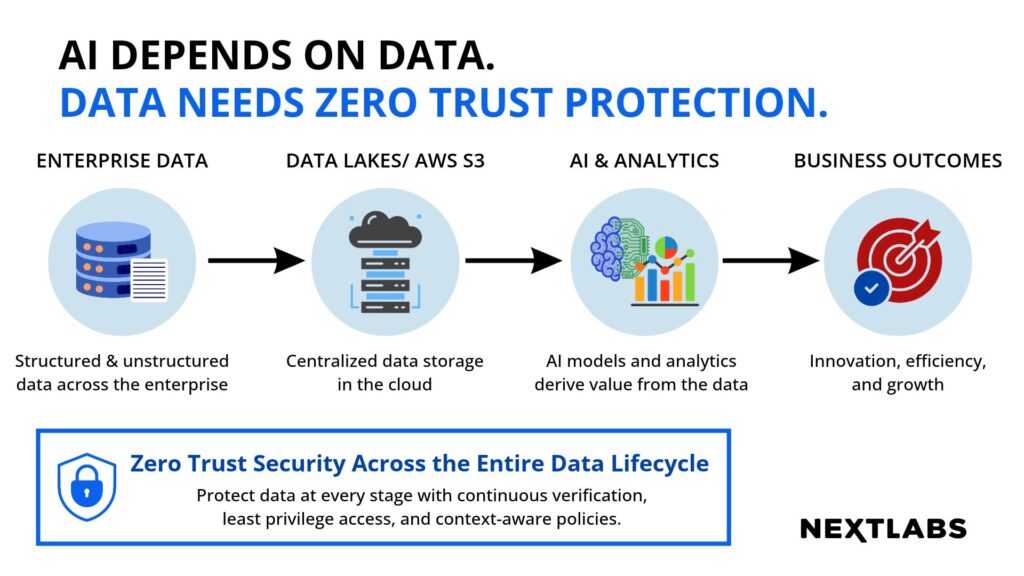
From training AI models and building large-scale data lakes to powering advanced analytics and business intelligence, organizations are increasingly dependent on vast volumes of enterprise data. As this reliance grows, protecting data wherever it resides, is accessed, and is used has become a critical cybersecurity priority.
AWS S3: A Critical Repository for Enterprise Data
AWS S3 has evolved into one of the most important repositories for enterprise data, supporting many AI and Big Data initiatives.
Organizations rely on AWS S3 to store massive datasets, support machine learning workloads, build data lakes, and enable large-scale analytics. The success of these initiatives depends on the availability, quality, and accessibility of the data stored within these environments – making security and governance essential.
However, as data volume and usage expand, so does the attack surface.
Why Traditional Security Models Are No Longer Enough
Traditional perimeter-based security models are no longer sufficient.
These approaches were designed for a world where users, applications, and data operate within clearly defined boundaries. Simply assuming that users, applications, or workloads inside the network can be trusted creates significant risk – especially as data is increasingly accessed by cloud-native applications, AI platforms, third-party services, and distributed workforces.
The challenge today is that data is no longer confined within traditional enterprise boundaries. Organizations must ensure that security controls remain effective regardless of where data is stored, where users operate, or how applications access it.
This is where Zero Trust Data Security approach becomes essential.
Applying Zero Trust to Protect AWS S3 Data
A Zero Trust approach operates on a simple principle – Never trust. Always verify.
For AWS S3 environments, this means organizations must move beyond securing infrastructure alone and focus on protecting the data itself.
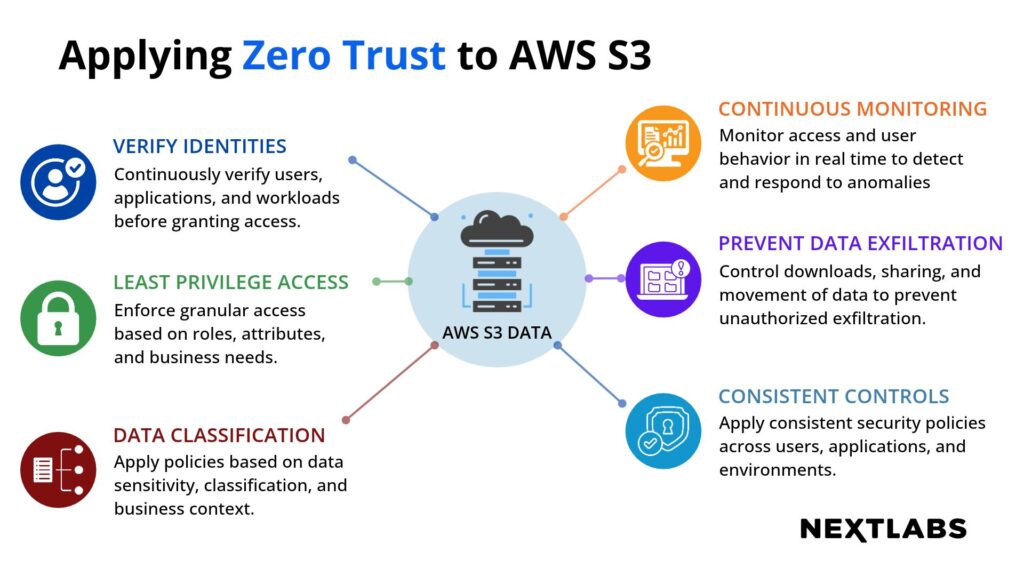
A zero trust data security approach applies continuous verification and dynamic access controls to ensure that access decisions are based on context, not just user identity. This approach is often enabled through Attribute-Based Access Control (ABAC), which allows organizations to enforce dynamic policies based on attributes associated with users, applications, environments, and data.
This enables organizations to:
Continuously verify user and application identities before granting access
Enforce least-privilege access policies based on business requirements
Protect data based on its sensitivity, classification, and business context
Monitor and audit access activities continuously
Prevent unauthorized downloads, sharing, and data exfiltration
Apply consistent security controls regardless of where users, applications, or workloads reside
Protecting the Data That Powers the Future
The challenge today is no longer just securing infrastructure – it is securing data throughout its entire lifecycle.
As AI and Big Data become increasingly embedded into enterprise operations, protecting the vast volumes of data that fuel these systems will become one of the most important cybersecurity priorities for business leaders.
Organizations investing heavily in AI and Big Data must ensure that their AWS S3 environments are not only scalable and performant but also governed by a robust zero trust data security approach.
Because in the AI era, the most valuable asset is not just the model.
It is the data behind it.
And data deserves Zero Trust protection.
As organizations continue to accelerate their AI and Big Data initiatives, the conversation around data security must evolve. How is your organization approaching zero trust data protection in the AI era?