What is Zero Trust Architecture (ZTA)?
Zero Trust Architecture (ZTA) is a cybersecurity framework that eliminates implicit trust and continuously verifies every user, device, application, and connection before granting access to enterprise resources. Built on the principle of “never trust, always verify,” ZTA helps organizations reduce cyber risk, prevent lateral movement, and secure modern cloud and hybrid environments.
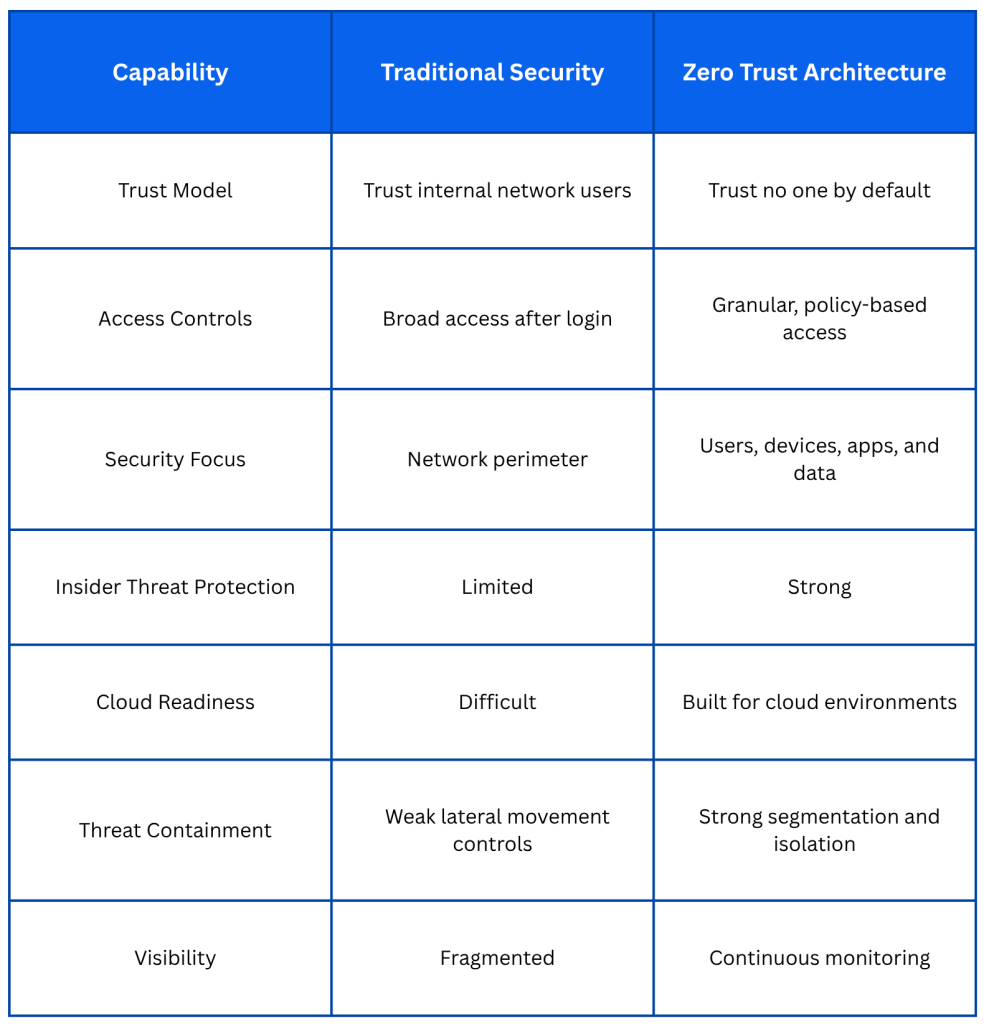
Unlike traditional perimeter-based security models that automatically trust users inside the network, zero trust assumes that no user or system should be trusted by default. Every access request is evaluated dynamically based on identity, device posture, location, behavior, risk level, and data sensitivity.
As organizations adopt cloud computing, remote work, SaaS applications, and third-party collaboration, Zero Trust Architecture has become a foundational approach to enterprise cybersecurity.
Why Organizations Are Adopting Zero Trust Security
Modern enterprises operate in highly distributed environments where users, devices, applications, and sensitive data exist far beyond traditional network boundaries. Legacy security approaches struggle to protect against modern cyber threats because they rely too heavily on perimeter defenses.
Zero trust security addresses these challenges by continuously validating trust and enforcing granular access controls across the enterprise. Designed to address threats that bypass traditional perimeter-based security, zero trust security focuses on protecting data and resources directly, rather than relying on a trusted network boundary. It uses technologies such as identity and access management (IAM), segmentation, and encryption to enforce security policies and limit access on a need-to-know basis—principles that are foundational to zero trust data security.
Using NextLabs to Implement the Department of Defense (DoD) Zero Trust Reference Architecture
Discover how how NextLabs simplifies the implementation of Zero Trust Architecture in alignment with DoD ZTA Reference Architecture for stakeholders
Proactive Protection with Zero-Trust Data-Centric
Learn how to secure an expanding digital core with Zero-Trust Data-Centric Security
A Zero trust approach addresses:
Expanded Attack Surface
Adoption of cloud computing and remote work has broadened the attack surface for organizations, leaving them vulnerable to cyberattacks.
Increased Data Sharing
Sharing data with different stakeholders across an extended enterprise increases the risk of breaches that would damage reputation and customer trust.
Compliance
Many industries are subject to strict regulatory requirements around data access, such as HIPAA, PCI DSS, and GDPR.
Evolving Threat Landscape
Traditional security models are struggling to keep up with evolving risks, such as insider threats and supply chain attacks.
Core Principles of Zero Trust Security
Zero Trust Architecture is built around several core principles that help organizations reduce risk while enabling secure collaboration and digital transformation.
Never trust, always verify: All users, devices, and applications must be verified and authenticated before being granted access to any resources or data.
Least privilege access: Access should be granted on a need-to-know basis, and users should only be granted the minimum level of access required to perform their job functions.
Assume breach: Assume that an attacker has already compromised a secure resource and act accordingly to limit the attacker’s access and ability to move laterally within the network, system, application, or database.
Micro-segmentation: Segment resources into small, isolated zones to limit the spread of a breach and prevent attackers from moving laterally.
Continuous monitoring: All access attempts must be continuously monitored for signs of suspicious behavior, and appropriate action must be taken in response to any suspicious activity.
Contextual awareness: Security policies and access controls must be based on contextual awareness, such as the user’s role, device location, and sensitivity of the data being accessed.
Together, these principles define how zero trust security is enforced across users, systems, and data.
How Zero Trust Architecture Works
Zero Trust Architecture continuously evaluates trust before and during access to enterprise resources.
A typical zero trust workflow includes:
- A user or application requests access to a resource
- Identity is verified through authentication controls such as SSO or MFA
- Device posture and compliance are validated
- Security policies evaluate contextual risk factors
- Least-privilege access is granted dynamically
- Activity is continuously monitored for anomalies
- Access can be restricted or revoked if risk changes
This continuous verification model helps organizations prevent unauthorized access while improving visibility across users, devices, applications, and data.
Key Components of a Zero Trust Architecture
Successful zero trust initiatives rely on multiple integrated technologies and policy controls.
Identity and Access Management (IAM)
Identity becomes the new security perimeter. IAM solutions authenticate users and manage authorization decisions.
Multi-Factor Authentication (MFA)
MFA strengthens identity verification by requiring additional authentication factors.
Data-Centric Security
Data-centric controls apply security policies directly to sensitive information, regardless of where the data travels.
Policy Engine
A centralized policy engine evaluates access requests dynamically using contextual information and business rules.
Endpoint Security
Endpoints are continuously monitored for compliance, vulnerabilities, and suspicious activity.
Encryption
Encryption protects sensitive data both at rest and in transit.
Logging and Analytics
Centralized logging and monitoring improve visibility, threat detection, compliance reporting, and incident response.
How Zero Trust Architecture Works
Traditional security models focus primarily on securing networks and infrastructure. However, modern enterprises require security controls that directly protect sensitive data itself.
A data-centric zero trust approach enables organizations to:
- Protect data across cloud and hybrid environments
- Secure collaboration with external parties
- Enforce consistent policies across applications
- Reduce insider threat risks
- Maintain compliance with regulatory requirements
- Prevent unauthorized sharing and exfiltration
By applying controls directly to sensitive data, organizations can maintain security even when data moves outside traditional enterprise boundaries.
Data-Centric Zero Trust Security with NextLabs
NextLabs helps enterprises operationalize Zero Trust Architecture through policy-driven, data-centric security controls that protect sensitive information across cloud platforms, enterprise applications, collaboration tools, and hybrid environments.
Unlike traditional network-centric approaches, NextLabs applies security policies directly to the data itself, enabling organizations to maintain control regardless of where the data moves.
Organizations use NextLabs to:
- Enforce least-privilege access
- Secure intellectual property and regulated data
- Control access dynamically using contextual attributes
- Monitor and audit user activity
- Enable secure collaboration across distributed environments
- Simplify compliance reporting and governance
CloudAz:
Zero Trust Policy Platform
CloudAz is a zero trust security policy platform that leverages a data-centric approach to provide continuous authentication and authorization of users, devices, and applications—safeguarding sensitive data beyond the network perimeter.
Policy Governance
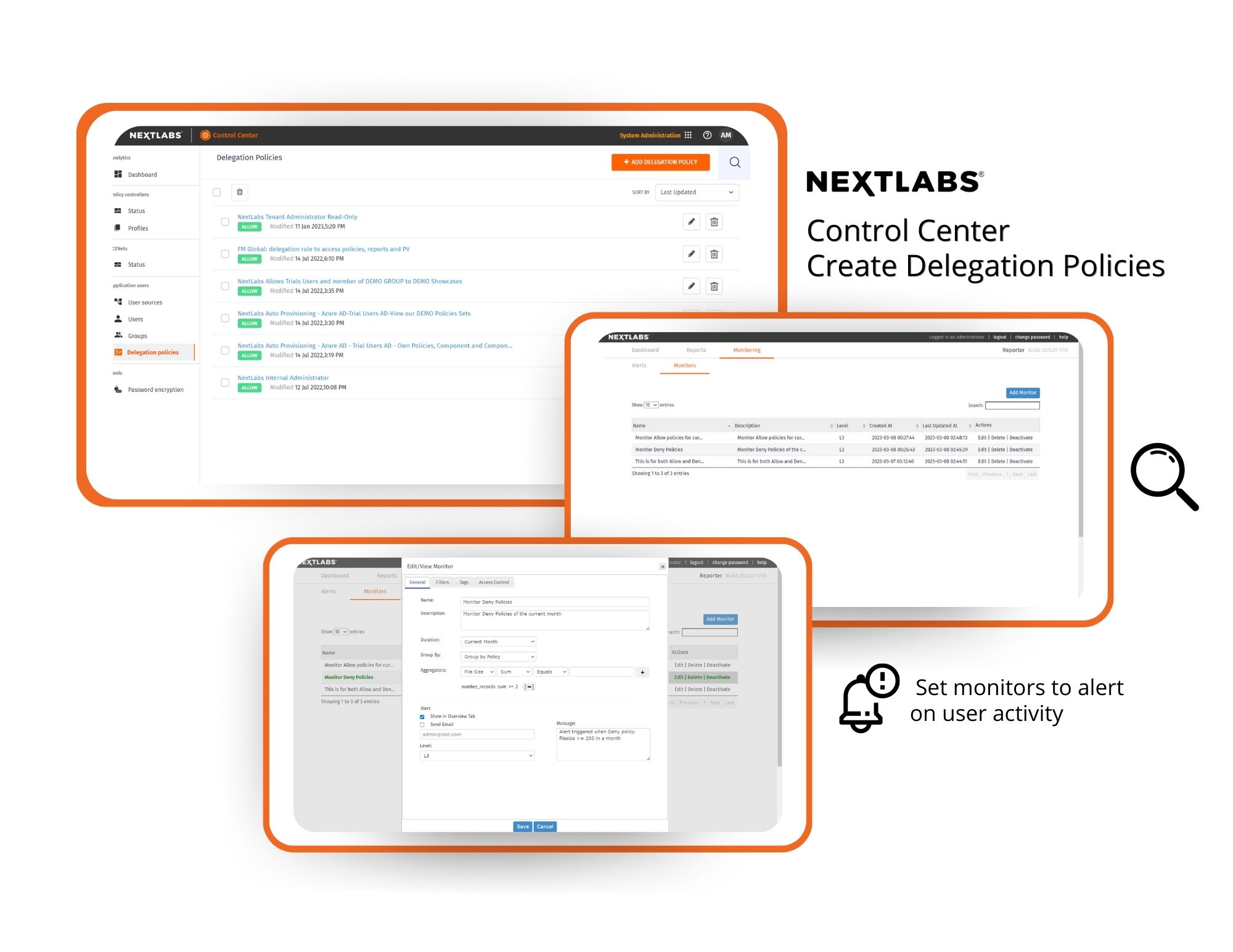
Users can easily author and oversee policies effectively with features such as approval workflows, version control and rollback, ensuring the system stays uncompromised.
Policy Evaluation
Digital policies are evaluated in real time by the policy engine, which authorizes access based on contextual factors, user behavior, and data sensitivity. This ensures that organizational resources are constantly secured by a "never trust, always verify" strategy, regardless of their location or context.
Central Activity Log
All access attempts and authorization decisions are stored in a centralized log, where anomalous activity can be monitored, tracked and reported. This simplifies compliance reporting and enables the fine-tuning of zero trust security policies.
Quick Time-to-value & Deployment: Seamlessly integrated with enterprise applications and business processes, runs in cloud natively
Seamless User Experience: Simply policy authoring, business-friendly UI, no custom coding required
Robust Security & Audit: Strong monitoring and policy governance features ensure secure deployment without fear of compromise
Scalability & Performance: Highest performing zero-trust policy engine in the industry, with high availability and scalability
Aligned with NIST and DoD Zero Trust Guidance
Zero Trust Architecture has become a major cybersecurity priority across both commercial enterprises and government agencies.
NextLabs supports zero trust initiatives aligned with:
- NIST SP 800-207 Zero Trust Architecture guidance
- Department of Defense (DoD) Zero Trust Reference Architecture
- Modern compliance and cybersecurity frameworks
By combining centralized policy management, data-centric security, and continuous authorization, organizations can accelerate zero trust adoption while improving operational resilience.
How does this fit into an Intelligent Enterprise Solution?
Implementing zero trust security principles allows organizations to embrace digitization, collaboration, and innovation without sacrificing data security. By enforcing security policies consistently across the organization and monitoring how sensitive data is accessed and used, a zero trust security solution enables safe migration to a more digitized and connected environment.
Frequently Asked Questions
What is Zero Trust Architecture?
Zero Trust Architecture is a cybersecurity framework that continuously verifies users, devices, applications, and access requests before granting access to resources.
What are the core principles of zero trust?
The primary principles include never trust, always verify; least-privilege access; assume breach; continuous monitoring; and contextual access control.
How does zero trust improve security?
Zero trust reduces unauthorized access, limits lateral movement, strengthens identity verification, and improves visibility across enterprise systems.
What is the difference between zero trust and traditional security?
Traditional security trusts users inside the network perimeter, while zero trust continuously verifies all access requests regardless of location.
Is Zero Trust Architecture required by NIST?
NIST strongly recommends zero trust principles through SP 800-207 guidance for modern enterprise cybersecurity strategies.
What industries benefit from zero trust security?
Industries including healthcare, finance, manufacturing, government, defense, technology, and critical infrastructure commonly adopt zero trust frameworks.
What is data-centric zero trust security?
Data-centric zero trust applies security policies directly to sensitive information rather than relying solely on network-based controls.