Strong identity is only the beginning for securing agentic AI. Explore how Zero Trust authorization, dynamic policies, ABAC, and data-centric …
Explore how NextLabs Application Enforcer adds fine-grained, data-level access control to SAP applications without custom code, enforced from one central …
Learn more about how Software Development Kit (SDK) Enforcer extends access control and compliance policies to custom applications, with SDKs …
NextLabs SkyDRM for Siemens Teamcenter extends PLM security with encryption, rights management, secure sharing, auditing, and protection for CAD, NX, …
Explore how NextLabs Application Enforcer secures enterprise cloud applications with ABAC, real-time policy enforcement, compliance automation, and data governance.
Explore NextLabs SkyDRM for SAP as a rights management solution that empowers users to classify and safeguard data, regardless of …
Explore how Enovia PLM Enforcer extends Enovia's native authorization model to protect product data throughout its lifecycle, using flexible policies …
NextLabs SkyDRM provides persistent protection for digital information throughout its lifecycle- whether files are at rest, in use, or being …
Explore how SkyDRM integrates with Bentley ProjectWise to enforce dynamic access control on protected confidential files both within and outside …
Explore how NextLabs SkyDRM provides centralized management, control, and activity analytics to files and emails across Microsoft Platforms.
Explore how organizations can strengthen ITAR and EAR compliance, protect controlled technical data, automate access controls, and reduce regulatory risk …
Explore how NextLabs SkyDRM extends security and usage control to file storage to achieve persistent protection for sensitive data.
Explore how financial institutions can strengthen information risk management through a centralized, policy-driven approach to data security.
Learn more about how NextLabs SkyDRM delivers real-time, persistent data protection directly inside enterprise's CAD applications.
Explore how enterprises can safeguard and manage AI-Generated outputs through Digital Rights Management (DRM)
Data filtering helps organizations refine large datasets while protecting sensitive information through policy-based access controls. It improves data quality, supports …
Explore the full Access Control family, the specific baseline requirements across impact levels, and how NextLabs addresses NIST 800-53 requirements.
Co-written with KuppingerCole’s analysts, Nitish Deshpande and Alejandro Leal, the Buyer’s Compass – Policy Based Access Management (PBAM) and Cloud …
The Electronic Export Control solution is designed to address export control requirements dealing with the handling and protection of defense …
Discover secure supply chain collaboration with policy-driven controls that protect sensitive data, prevent unauthorized access, and ensure compliance without slowing …
NextLabs, in partnership with SAP, addresses data security challenges with SAP Enterprise Digital Rights Management, a solution designed to secure …
A Technical Data Export Compliance solution that enforces data-centric security within SAP workflows, helping organizations meet ITAR, EAR, and BAFA …
Explore how policy and access visibility in Zero Trust security enables organizations to monitor activity, analyze user behavior, and enforce …
Learn what Zero Trust Security is and how it helps organizations protect sensitive data by continuously verifying users, devices, and …
Federal agencies face increasing pressure to protect sensitive data amid evolving threats and a growing need for interagency collaboration. VAST …
Consolidating multiple SAP instances into a single shared environment reduces cost and inefficiency but creates a serious security problem: critical …
As regulatory frameworks multiply and overlap, the organizations are best positioned to manage compliance when adopting to a unified, proactive, …
An innovative approach to balance the need for timely access with the need to protect sensitive information and comply with …
As SAP environments increasingly move to hyperscale cloud platforms, protecting sensitive data has become a critical security and compliance requirement. …
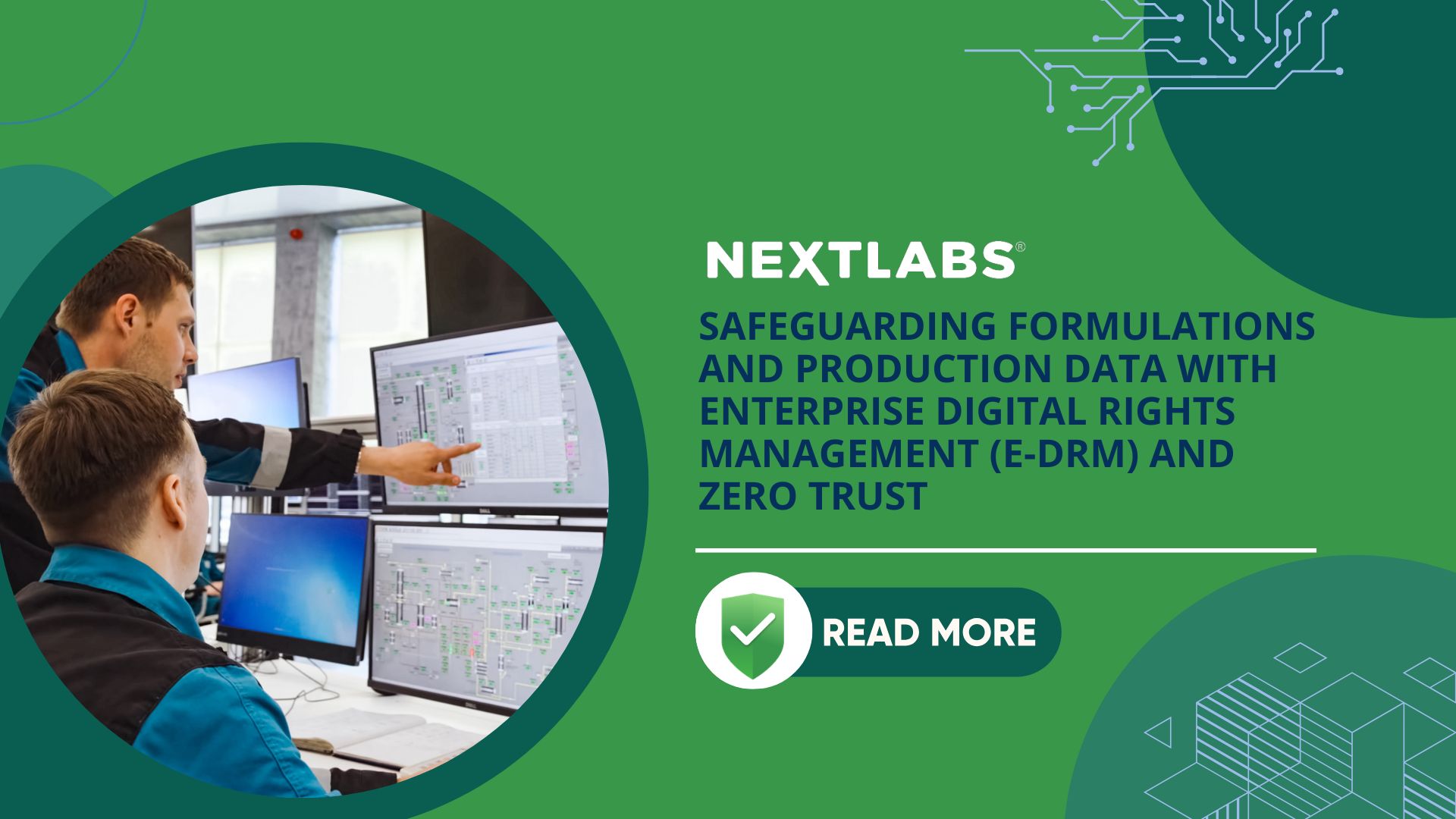
E-DRM enhanced with Zero Trust principles provides persistent protection for sensitive formulations, batch records, and production data, helping manufacturing organizations …
Discover how Zero Trust policy orchestration centralizes and automates security policies to enforce consistent access control and reduce human error …
Learn how the Zero-Trust Security Model enables secure collaboration, protecting sensitive data across Google Workspace, Teams, and SharePoint with encryption, …
Learn how the Zero-Trust Security Model ‘never trust, always verify’ protects data, users, and networks with strict access and continuous …
Explore a modern security approach that assist enterprises to protect sensitive data and limit ransomware impact with Zero Trust Data …
The General Data Protection Regulation (GDPR) has fundamentally reshaped how organizations manage and protect personal data. Enforced nearly a decade …
Learn more about a data-centric security solution to ensure persistent data protection and regulatory compliance across multiple cloud environments.
Strengthen audit and compliance programs with continuous monitoring, entitlement analysis, and compliance reporting. Gain visibility into sensitive information, validate controls, …
Explore the data-centric security solution that ensures enterprises' IP remains protected regardless of where or how it is accessed.
A clear overview of the Software Development Life Cycle (SDLC), including its key phases and development models, and how modern …
A clear overview of operational resilience, including how organizations withstand disruptions, maintain critical services, and strengthen cybersecurity and third-party risk …
Zero-Trust data-centric security protects sensitive data beyond the perimeter with continuous verification, fine-grained access control, and policy enforcement.
Enforce policy-based control over ePHI access and handling to reduce data disclosure risk, improve visibility, and accelerate HIPAA compliance.
Basel II compliance solution to identify, control, and audit sensitive financial data flows, reduce operational risk, and support regulatory audits.
Cyber security for SAP data with fine-grained, policy-based access and usage control to reduce cyber risk and improve regulatory compliance.

Explore the data-centric security solution for design and manufacturing companies to centrally manages and controls risks associated with IP, client …
Home | Intelligent Enterprise | The Future of Data Security for AI | AI Model Attacks Explained: Securing Model Integrity …
Automated access control secures digital systems by enforcing real-time, policy-based access decisions. It reduces risk, improves compliance, and streamlines access …
Global product development risks IP loss and compliance violations. Secure Engineering Collaboration protects intellectual property while enabling controlled collaboration.
Explore Active Control for Healthcare Data Protection ensures proper access, handling, and disclosure of patient records and health insurance subscriber …
AI model theft is an increasing enterprise risk, enabling attackers to replicate proprietary AI models through unauthorized access, extraction, or …
Adversarial AI attacks exploit machine learning models by manipulating input or training data, leading to incorrect decisions and hidden risk. …

AI model poisoning is one of the most dangerous and least understood threats facing enterprise AI systems. By corrupting training …

Explore use cases to learn how data-centric security solution for ITAR compliance protects technical data across extended A & D …
AI security frameworks and governance explained: learn how Zero Trust enables trustworthy, compliant, and secure AI across data, models, and …
Data filtering helps organizations refine large datasets while protecting sensitive information through policy-based access controls. It improves data quality, supports …

Data access control defines who can access sensitive data and under what conditions. It protects organizations from unauthorized access, supports …
AI model poisoning is one of the most dangerous and least understood threats facing enterprise AI systems. By corrupting training …

As government agencies integrate data to power AI initiatives, the risk of exposure grows dramatically. Traditional perimeter defenses are no …
Learn what data scrambling is, how it works, and why it’s essential for protecting sensitive information in testing, development, analytics, …
Expanding collaboration across project teams, suppliers, and international partners significantly increases the number of touchpoints where sensitive SAP data can …

In today’s digital-first world, the old ways of defending enterprise systems—guarding the network perimeter and trusting everything inside it—just don’t …
In research, design, and engineering environments, product data sits at the heart of innovation. It contains intellectual property, technical specifications, …

Discover how Data-Centric Security enables Zero Trust Application Protection, securing enterprise apps, workloads, and APIs against modern threats.

As organizations accelerate digital transformation and data collaboration across global ecosystems, protecting sensitive information has become increasingly complex. Traditional Digital …
Enterprise Resource Planning (ERP) systems form the digital backbone of today’s organizations. By unifying core business functions from finance and …
AI outputs drive critical business decisions, shape customer experiences, and influence strategic outcomes. Yet, many organizations fail to secure the …
Data is the lifeblood of Artificial Intelligence — powering every prediction, recommendation, and decision. But as AI systems consume vast …
Learn why securing AI models is critical. Protect model integrity, intellectual property, and decision-making using Zero Trust and Data-Centric Security.
Why securing access to AI systems is the foundation of AI security. Learn how Zero Trust and policy-based controls protect …
CISA’s ZTMM model provides a structured approach for federal agencies to transition to Zero Trust Architecture and adopt a data-centric …
Information Labeling and Handling (ILH) provides a unified framework for protecting sensitive data and enabling trusted collaboration across global enterprises. …

Many enterprises need to securely protect information and comply with export control regulations. Export controls govern the information that cannot …

The NextLabs eGRC platform introduces a policy-based control framework that directly enforces export control rules like ITAR and EAR at …
To meet new demands, RBAC must evolve to incorporate a more dynamic, context-aware model capable of managing fine-grained access control …
Discover how NextLabs applies zero trust principles and data-centric security to NIST 800-53, enhancing organizations’ security posture, business agility and …
Learn how data anonymization enhances data access security. Protect sensitive data, support compliance, and enable safe analytics with Zero Trust …
As organizations embrace data-driven decision-making, safeguarding sensitive information is more critical than ever. Traditional perimeter defenses can’t keep pace with …
Discover how preventative SoD controls diminish risks associated with conflicts of interest, fraud, and compliance violations.
Data breaches aren’t just headlines—they’re real threats happening inside organizations every day. According to IBM, the global average cost of …
As organizations embrace cloud-first strategies, remote work, and Zero Trust principles, old-school access control methods—like ACLs and static roles—just can’t …
Data Access Security ensures that sensitive information is protected at the point of access—enforcing policies in real time based on …
Discover how Attribute-based access control (ABAC) emerged as the next-gen cybersecurity technology for secure access control for extended enterprises.
This article dives into common data security challenges along digital transformation and provides solutions and use cases to demonstrate how …
Discover a comprehensive guide on how to effectively implement Zero Trust Architecture.
Enterprises increasingly rely on extranets to collaborate with partners, suppliers, customers, and remote employees, but these platforms introduce significant security …
Ransomware accounted for nearly 70% of global cyberattacks in 2023, targeting industries like healthcare, finance, manufacturing, and government. Explore the …
As the pace and complexity of software development continue to accelerate, securing the software development lifecycle (SDLC) has never been …
The Cybersecurity Maturity Model Certification (CMMC) is a U.S. Department of Defense framework designed to improve cybersecurity in the Defense …

Learn why securing sensitive data in AI models is critical. Protect PII, IP, and regulated data across large AI training …
In an environment where cyber threats are escalating and federal cybersecurity expectations are rising, protecting Controlled Unclassified Information (CUI) is …

As more organizations embrace Zero Trust security models, the need for fine-grained, dynamic access control has never been greater. Traditional …

As the Department of Defense (DoD) and other federal agencies move rapidly toward Zero Trust Architecture (ZTA), many organizations are …
Federated identity is a system that enables users to access multiple applications, services, or organizations using a single set of …
Federated authorization refers to a system of granting access rights to users across multiple organizations or systems without requiring them …

CISA’s ZTMM model provides a structured approach for federal agencies to transition to Zero Trust Architecture and adopt a data-centric …
In the dynamic and often perilous landscape of cybersecurity, safeguarding sensitive government data is not just a priority but a …

As enterprises continue to upgrade their SAP ERP systems to SAP S/4HANA, it is crucial to implement Zero Trust principles …
DLP ensures that sensitive information does not leave the corporate network. DLP is a combination of methods and technologies that …

Dynamic authorization is essential for securing modern, distributed IT environments because it provides real-time, adaptive access control that is context-sensitive …
Many enterprises need to securely protect information and comply with export control regulations. Export controls govern the information that cannot …

For the A&D industry and beyond, the intricate issues of electronic export compliance of technical data calls for a data-centric …

Safeguarding data during organizational changes requires dynamic security controls beyond conventional ones in response to drastic changes.
To protect intellectual property in a collaborative global supply chain, a data-centric solution with dynamic access management is necessary.

Data-centric security (DCS) involves technologies, processes, and policies whose focus is on the location of the data, its collection, storage, …
NextLabs’ Active Control Policy Language (ACPL) is a fourth generation policy language (4GL) based on the XACML standard for access …
In this overview, we dive into importance of implementing a zero-trust architecture (ZTA) and how enterprises can extend its efficacy.
Explore why Role-Based Access Control (RBAC) should be enhanced with Attribute-Based Access Control (ABAC) in this globalized and ever-changing world.

Discover how NextLabs Data Access Enforcer reaches dynamic data protection through enhancing Role-Based Access Control with Attribute-Based Access Control.
Data safety and zero-trust are the new norm of data centric security in a global business world constructed by cloud, …

To ensure the realization of these benefits, it is essential to establish best practice guidelines for successful ABAC implementation. Discover …

Zero Trust and Data Centric security can be complementary approaches to security. Zero Trust can help to limit access to …
NIST Cybersecurity Framework (CSF) 2.0 introduces major updates to strengthen how organizations manage cybersecurity risks, featuring five key takeaways from …
Explore how a data loss prevention solution can protect SAP data regardless of where it resides throughout its lifecycle.

Attribute-Based Access Control (ABAC) is a security model that secures data dynamically with attribute-driven policies.
Dynamic authorization is a technology in which authorization and access rights to an enterprise’s network, applications, data, or other sensitive assets …
NextLabs’ Active Control Policy Language (ACPL) is a fourth generation policy language (4GL) based on the XACML standard for access …
A policy engine is an essential component of Zero-Trust Architecture (ZTA), which has gained popularity in recent years as a …
Many enterprises need to securely protect information and comply with export control regulations. Export controls govern the information that cannot …
Many enterprises need to securely protect information and comply with export control regulations.

Segregation of duties (SoD), also called separation of duties, is a fundamental aspect to sustainable internal controls and risk management.

Export Controls are laws and regulations that govern the transfer or disclosure of goods, technology and funds originating in one …

Data segregation is the process of separating certain sets of data from other data sets so that different access policies …
We live in a dynamic world which requires organizations to be more responsive. Typically, information and application access policies are …

As defined by NIST, a zero trust architecture (ZTA) employs a data-centric methodology that focuses on protecting resources over the …
In this article, we will explore different types of AI threats, and four critical pillars of safeguarding AI based on …
Zero Trust Policy Management (ZTPM) applies Zero Trust principles for effective policy management. It is crucial to take a data-centric …
Runtime authorization enables authorization decisions to be made in real-time when the user is accessing an application or data.
Find out about Zero Trust Authorization and Zero Trust Data Security and how you can implement it for your organization.

Find out about Zero Trust Data Protection and Zero Trust Data Security and how you can implement it for your …

Format-Preserving Encryption, or FPE, refers to encryption where the encrypted output is in the same format as the input, or …
Learn more about how logical data segregation empowers organizations to efficiently manage data, enhance data governance, and build trust with …
Discover Logical data segregation - the practice of logically separating data based on specific criteria like sensitivity, access requirements, and …
A SASE architecture streamlines network access and improves the adherence to security and compliance policies by identifying users and devices …

ITAR Compliance refers to the adherence to the regulations outlined in the International Traffic in Arms Regulations (ITAR), a crucial …

Document security refers to measures taken to prevent data in documents from being wrongfully accessed, manipulated, or reproduced. Examples of …

Centralized policy management is an essential component of a successful Zero Trust implementation. By consolidating and managing access policies from …
File security refers to the methods and techniques used to protect files and data from unauthorized access, theft, modification, or …
The current exponential growth of global digital business networks results in the need for enterprises to apply DRM for managing, …

Dynamic data masking applies real-time data anonymization based on user user attributes, data sensitivity, and the environment at the moment …

Digital rights management protects sensitive, business-critical data, enabling secure creation, editing, and sharing in dynamic, collaborative environments.

Information Rights Management extends far beyond traditional data security measures. It is the solution that allows organizations to maintain the …
Policy enforcement in data security refers to the process of ensuring that the security policies and procedures implemented by an …
Document security, or document access security, is the process of safeguarding documents and files from unwanted access or theft. It …
ITAR-related technical data refers to information, or data that provides details about the design, development, or use of defense articles.
Policy Lifecycle Management is the process of creating, implementing, monitoring, reviewing, and updating current data security policies.
In an extended enterprise ecosystem, companies encounter numerous challenges of protecting their confidential PLM data.

Data Access Service Edge (DASE) is an extension of SASE, designed to fortify data access in hybrid and multi-cloud environments …

DRM plays a major role in policy-driven data protection and is a popular tool for securing data both in transit …
Extending PLM security to protect digital twin is paramount to prevent potential data breach, especially in supply chain collaboration.
In today’s competitive landscape, product design and development are vital. Companies use CAD and PLM software to optimize processes and …
One of the biggest concerns for organizations is how to ensure that the data they keep on shared systems is …
SharePoint holds some of an organization’s most valuable information, including intellectual property, trade secrets, research, and transactional data. As teams …
As more data is shared across enterprise networks, file servers, and cloud environments, organizations need a solution to not only …
Product designs created by designers and engineers with Computer-Aided Design (CAD) tend to be deemed as intellectual property (IP) of …
As more data becomes available for sharing across a variety of networks, static security measures are proving ineffective at stopping …
The National Institute of Standards and Technology (NIST) created Role-Based Access Control (RBAC) in 1992 and it quickly became the …