Protecting Sensitive Data Wherever It Goes
As organizations continue their digital transformation, sensitive data is constantly being created, shared, and accessed across cloud platforms, SaaS applications, endpoints, and hybrid work environments. While these technologies improve productivity and collaboration, they also expand the attack surface, making it increasingly difficult to protect confidential information from unauthorized access, accidental exposure, and cyber threats.
Traditional security models were designed to defend network perimeters. However, today’s data rarely stays within those boundaries. Employees work remotely, partners require access to business-critical information, and organizations rely on multiple cloud services to support daily operations. As data moves across users, devices, applications, and locations, protecting the network alone is no longer enough. Organizations must focus on protecting the data itself.
Data Loss Prevention (DLP) helps organizations maintain control over sensitive information by identifying, monitoring, and protecting data throughout its lifecycle. Whether data is stored, shared, or actively being used, DLP enables organizations to reduce risk, support regulatory compliance, and prevent costly data breaches through policy-driven security controls.
What is Data Loss Prevention?
Data Loss Prevention (DLP) is a cybersecurity strategy that combines technologies, policies, and processes to prevent sensitive information from being lost, leaked, misused, or accessed by unauthorized users. DLP solutions identify sensitive data, classify it according to organizational policies, monitor how it is used, and enforce security controls that help prevent unauthorized disclosure.
Unlike traditional security approaches that focus primarily on protecting networks or devices, DLP takes a data-centric approach, ensuring that security follows the data wherever it resides. Modern DLP solutions protect data across on-premises infrastructure, cloud applications, SaaS platforms, endpoints, and hybrid environments.
Effective DLP solutions help organizations protect a wide range of sensitive information, including:
- Personally Identifiable Information (PII)
- Protected Health Information (PHI)
- Financial records
- Customer and employee data
- Intellectual property
- Engineering designs and CAD files
- Source code
- Legal and contractual documents
- Export-controlled information
- Confidential business information
By applying consistent, policy-based controls across data at rest, in motion, and in use, DLP enables organizations to reduce security risks while allowing employees and business partners to collaborate securely.
Why Data Loss Prevention Matters
Data has become one of every organization’s most valuable assets. From customer information and financial records to proprietary research and intellectual property, sensitive data drives business operations and innovation. At the same time, it has become a primary target for cybercriminals, insider threats, and accidental exposure.
Today’s organizations face increasingly complex security challenges, including:
- Remote and hybrid workforces
- Cloud adoption and SaaS applications
- Third-party collaboration
- Insider threats
- Ransomware attacks
- Compromised credentials
- Increasing regulatory requirements
Without appropriate controls, sensitive information can easily be copied, downloaded, shared externally, or stored in unauthorized locations, leading to financial losses, reputational damage, regulatory penalties, and operational disruption.
Data Loss Prevention helps organizations reduce these risks by providing visibility into where sensitive data resides, how it is being used, and who has access to it. By enforcing security policies in real time, DLP enables organizations to protect critical information without unnecessarily restricting legitimate business activities
What Causes Data Loss?
Data loss is not always the result of sophisticated cyberattacks. In many cases, sensitive information is exposed through everyday business activities or human error. Understanding the most common causes of data loss is essential for building an effective security strategy.
Human Error
Employees may accidentally email confidential documents to the wrong recipient, upload files to unauthorized cloud storage, or share sensitive information without realizing the potential consequences. These mistakes remain one of the leading causes of data breaches.
Insider Threats
Insider threats can be either malicious or unintentional. Employees, contractors, or third-party partners with legitimate access to sensitive information may misuse data for personal gain or inadvertently expose it through careless behavior.
Cyberattacks
Threat actors use phishing, ransomware, malware, credential theft, and social engineering attacks to gain unauthorized access to sensitive information. Once inside an environment, attackers often attempt to locate and exfiltrate valuable data.
Cloud Misconfigurations
As organizations adopt cloud services, improperly configured storage repositories and excessive user permissions can unintentionally expose sensitive information to unauthorized users or even the public internet.
Third-Party Data Sharing
Organizations increasingly collaborate with suppliers, contractors, and business partners. While collaboration is essential, sharing sensitive information outside organizational boundaries introduces additional security risks unless appropriate access and usage controls are enforced.
Endpoint Risks
Laptops, mobile devices, USB drives, and remote work environments continue to create opportunities for data loss. Lost or stolen devices, unauthorized downloads, removable media, and unmanaged endpoints can all lead to the exposure of sensitive information.
Regardless of how data loss occurs, organizations need visibility into sensitive information, the ability to control how it is accessed and used, and security policies that adapt to changing users, devices, locations, and business contexts. This is where modern, data-centric Data Loss Prevention solutions provide significant value by protecting information wherever it travels.
How Data Loss Prevention Works
Data Loss Prevention works by identifying sensitive information, monitoring how that information is accessed and shared, and enforcing security policies when risky activity is detected. Rather than relying solely on network boundaries, DLP focuses on protecting the data itself throughout its lifecycle.
A modern DLP solution typically follows five key steps:
- Discover Sensitive Data: The first step is to locate sensitive information across the organization. This may include data stored in databases, file shares, cloud repositories, email systems, SaaS applications, endpoints, and collaboration platforms.
- Classify Data: Once discovered, data is classified based on its sensitivity and business value. Common classifications include public, internal, confidential, restricted, regulated, and highly sensitive data.
- Monitor Data Activity: DLP continuously monitors how sensitive information is accessed, used, copied, downloaded, uploaded, printed, emailed, or shared. This visibility helps security teams understand normal data usage patterns and identify unusual behavior.
- Enforce Security Policies: When a policy violation occurs, the DLP solution can automatically enforce controls. Depending on the policy, it may block the action, encrypt the data, mask sensitive information, quarantine the file, restrict access, or alert security teams.
- Respond and Report: DLP provides audit trails, incident reports, and alerts that help organizations investigate potential data loss events, demonstrate compliance, and improve security policies over time.
How DLP Enforcement Works in Practice
For example, if an employee attempts to email a spreadsheet containing customer financial data to a personal email account, the DLP solution can detect the sensitive content, evaluate the context of the request, and automatically block the transmission before the data leaves the organization.
This real-time enforcement is what makes DLP an effective control against accidental disclosure, insider threats, and unauthorized data exfiltration.
The Three States of Data
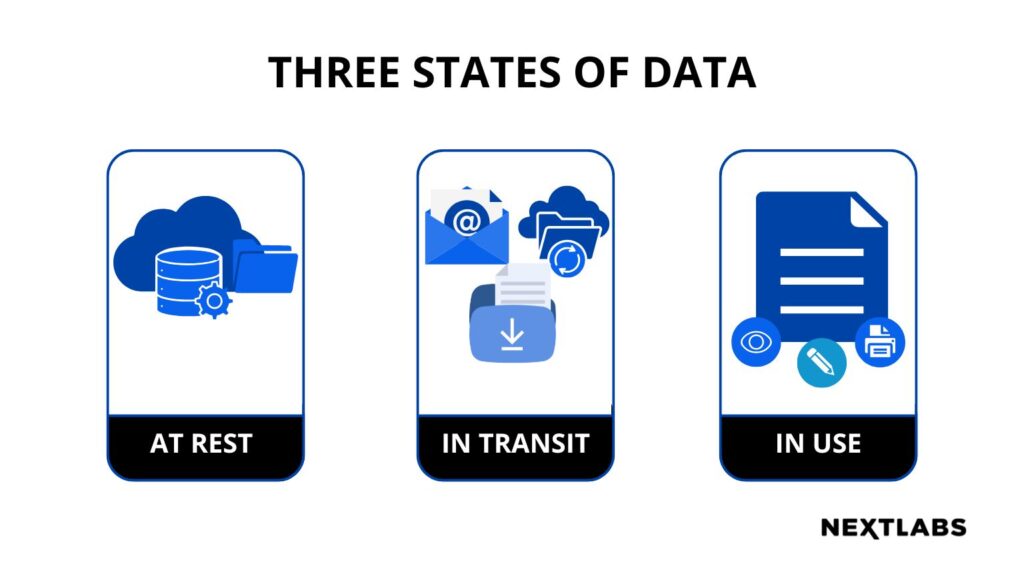
An effective Data Loss Prevention strategy protects sensitive information across all three states of data: data at rest, data in motion, and data in use. Each state presents different security risks and requires appropriate controls.
Data at Rest
Data at rest refers to information that is stored in databases, file systems, cloud repositories, backup systems, or archives. Although the data is not actively being used, it still requires protection against unauthorized access.
Examples include:
- Files stored on servers
- Cloud storage repositories
- Archived documents
- Databases containing customer records
- Backup copies of sensitive information
DLP helps protect data at rest through classification, access controls, encryption, and continuous monitoring.
Data in Motion
Data in motion refers to information being transmitted across networks, applications, email systems, cloud services, or collaboration platforms. This is one of the most vulnerable stages because data is actively moving between users and systems.
Examples include:
- Email attachments
- File uploads and downloads
- Cloud sharing
- API transfers
- Messaging platforms
- External collaboration
DLP policies can inspect data in transit and prevent unauthorized transfers before sensitive information leaves approved channels.
Data in Use
Data in use refers to information that is actively being accessed, processed, modified, copied, or viewed by users or applications.
Examples include:
- Opening a confidential document
- Copying data to the clipboard
- Printing sensitive files
- Taking screenshots
- Exporting reports
- Accessing data from a remote endpoint
DLP solutions can monitor these actions in real time and apply controls based on user identity, device type, location, and business context.
Summary of the Three Data States
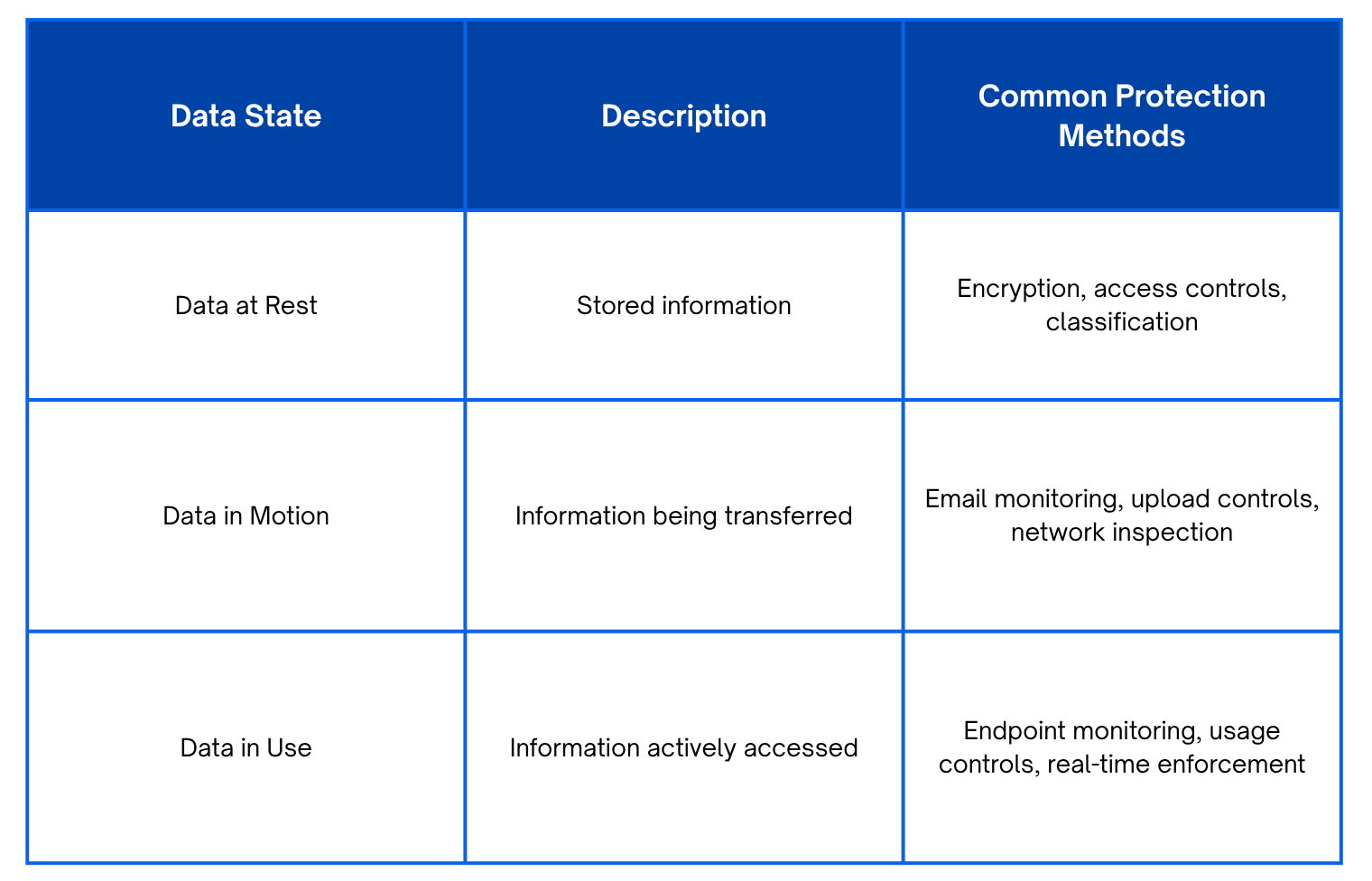
Protecting all three states of data is essential because sensitive information can be exposed at any point in its lifecycle.
Core Components of a DLP Solution
Modern DLP platforms combine multiple capabilities to provide comprehensive protection across on-premises, cloud, and hybrid environments.
Data Discovery
Automatically locates sensitive information across structured and unstructured data sources.
Data Classification
Categorizes data based on sensitivity, business value, and regulatory requirements.
Policy Management
Defines rules that determine how sensitive information can be accessed, used, shared, stored, and transmitted.
Monitoring and Visibility
Tracks data access, movement, sharing, copying, printing, and other user activities.
Real-Time Enforcement
Blocks, restricts, encrypts, masks, quarantines, or alerts when a policy violation occurs.
Incident Response and Reporting
Provides audit logs, alerts, dashboards, and reports for security investigations and compliance requirements.
Together, these components help organizations maintain visibility and control over sensitive information throughout its lifecycle.
Types of Data Loss Prevention
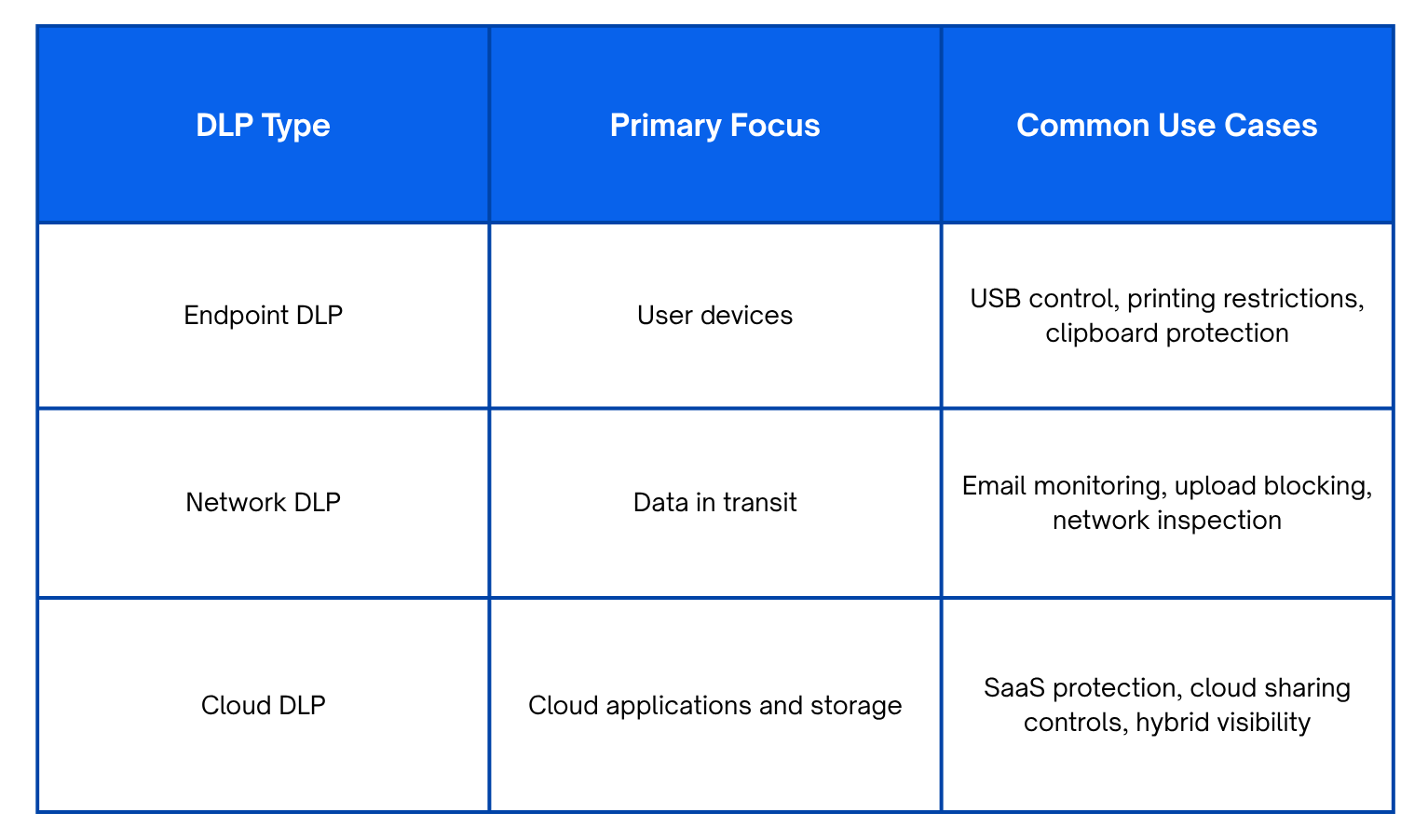
Most enterprise DLP strategies include a combination of endpoint DLP, network DLP, and cloud DLP. Each type addresses a different area of risk.
Endpoint DLP
Endpoint DLP protects sensitive data on laptops, desktops, mobile devices, and other user endpoints. It monitors how users interact with data and can prevent risky actions such as:
- Copying files to USB drives
- Uploading data to unauthorized cloud storage
- Printing confidential documents
- Taking screenshots
- Copying sensitive information to the clipboard
- Accessing data from unmanaged devices
Endpoint DLP is especially important for remote and hybrid work environments, where sensitive data may be accessed outside traditional corporate networks.
Network DLP
Network DLP monitors data as it moves across internal and external networks. It helps detect and prevent unauthorized transmission of sensitive information through channels such as:
- Web uploads
- File transfers
- Messaging applications
- API communications
- External network connections
By inspecting traffic in real time, network DLP can block data exfiltration before it occurs.
Cloud DLP
Cloud DLP protects sensitive information stored in cloud applications, SaaS platforms, and cloud storage repositories. As organizations adopt cloud services, cloud DLP has become a critical component of modern data protection strategies.
Cloud DLP helps organizations:
- Discover sensitive data in cloud storage
- Prevent unauthorized sharing
- Detect excessive permissions
- Monitor data movement between cloud services
- Enforce consistent policies across hybrid environments
- Support compliance requirements
Comparing Endpoint, Network, and Cloud DLP
A Unified Enterprise DLP Strategy
The most effective enterprise DLP solutions combine endpoint, network, and cloud protection into a unified strategy. This provides organizations with consistent visibility and policy enforcement across all locations where sensitive data is created, stored, accessed, or shared.
As data continues to move across users, devices, applications, and cloud environments, organizations need DLP solutions that can adapt to changing business requirements while maintaining strong security control
Benefits of Data Loss Prevention
Implementing a Data Loss Prevention (DLP) strategy helps organizations safeguard sensitive information while enabling employees, partners, and customers to collaborate securely. By providing visibility into how data is accessed, used, and shared, DLP reduces security risks without compromising productivity.
Reduce the Risk of Data Breaches
Data breaches can result in significant financial losses, regulatory penalties, operational disruption, and reputational damage. DLP helps reduce these risks by identifying sensitive information and preventing unauthorized access, sharing, or exfiltration before incidents occur.
By continuously monitoring data activity and enforcing policy-based controls, organizations can stop accidental disclosures and malicious attempts to move sensitive information outside approved channels.
Protect Intellectual Property
For manufacturers, engineering firms, software companies, and research organizations, intellectual property represents one of their most valuable assets. Product designs, source code, research data, and trade secrets require protection throughout their lifecycle.
DLP enables organizations to monitor access to intellectual property, restrict unauthorized downloads or sharing, and ensure sensitive files remain protected whether they are stored on-premises, in the cloud, or shared with external partners.
Strengthen Regulatory Compliance
Organizations operating in regulated industries must comply with data privacy and security regulations such as GDPR, HIPAA, CCPA, PCI DSS, ITAR, and GLBA.
DLP helps organizations meet these requirements by:
- Identifying and classifying regulated data
- Applying consistent security policies
- Restricting unauthorized access
- Monitoring data usage
- Maintaining audit trails for compliance reporting
By enforcing data protection policies automatically, organizations can reduce compliance risks while simplifying audits and governance processes.
Improve Visibility Into Sensitive Data
Many organizations struggle to answer fundamental questions such as:
- Where is our sensitive data stored?
- Who has access to it?
- How is it being used?
- Has it been shared outside the organization?
DLP provides comprehensive visibility into sensitive information across endpoints, cloud applications, collaboration platforms, file shares, and on-premises repositories. This insight allows security teams to identify risks, enforce governance policies, and respond more quickly to suspicious activity.
Enable Secure Collaboration
Today’s organizations rely on collaboration across employees, contractors, suppliers, and business partners. While collaboration drives innovation and productivity, it also increases the risk of unauthorized data exposure.
Modern DLP solutions enable organizations to share sensitive information securely by enforcing policies that determine who can view, edit, print, download, copy, or redistribute files. Instead of preventing collaboration, DLP allows organizations to collaborate with confidence while maintaining control over their most valuable information.
Common Data Loss Prevention Use Cases
Organizations across every industry use DLP to protect sensitive information from accidental exposure, insider threats, and cyberattacks. Below are some of the most common scenarios where DLP helps reduce risk and improve data security.
Prevent Unauthorized File Sharing
Employees frequently share documents through email, cloud storage, collaboration platforms, and messaging applications. Without proper controls, confidential information can easily be sent to unauthorized recipients.
DLP monitors file transfers in real time and can automatically block, encrypt, quarantine, or alert administrators when sensitive information is shared in violation of organizational policies.
Protect Remote and Hybrid Workforces
Remote work has expanded the number of devices and locations from which employees access corporate data. Laptops, mobile devices, and home networks introduce additional opportunities for data loss.
Endpoint DLP extends security beyond the traditional corporate network by monitoring user activity, preventing unauthorized downloads, controlling removable media, and protecting sensitive information regardless of where employees work.
Secure Cloud Applications and SaaS Platforms
Organizations increasingly store and share sensitive information in Microsoft 365, Google Workspace, Salesforce, SharePoint, Box, and other cloud services.
Cloud DLP provides visibility into sensitive data stored across cloud applications while enforcing consistent security policies that help prevent unauthorized access, downloads, or sharing.
Prevent Insider Threats
Not all insider threats are malicious. Employees may unintentionally expose sensitive information by using personal cloud storage, copying files to USB drives, or sending confidential documents to the wrong recipient.
DLP continuously monitors user behavior and data movement, allowing organizations to detect unusual activity, enforce least-privilege access, and prevent unauthorized data transfers before sensitive information leaves the organization.
Protect Intellectual Property During Collaboration
Organizations frequently collaborate with customers, suppliers, contractors, and business partners. While external collaboration is essential, it should not require sacrificing control over sensitive information.
DLP enables organizations to securely share engineering drawings, financial reports, legal documents, and product designs while controlling what external users are allowed to do with those files after they have been shared.
Industry-Specific DLP Examples
Although every organization manages sensitive information, the types of data that require protection vary across industries.
Healthcare
Healthcare organizations use DLP to protect electronic protected health information (ePHI), patient records, insurance information, and clinical research while supporting HIPAA compliance.
Financial Services
Banks and financial institutions protect customer financial records, payment data, investment information, and personally identifiable information (PII) while meeting regulatory requirements such as GLBA and PCI DSS.
Manufacturing
Manufacturers use DLP to safeguard engineering designs, CAD files, product specifications, supplier documentation, and intellectual property throughout the product development lifecycle.
Government and Defense
Government agencies and defense contractors use DLP to protect Controlled Unclassified Information (CUI), export-controlled data, classified information, and mission-critical documents while supporting Zero Trust initiatives.
Legal Services
Law firms rely on DLP to secure confidential client communications, contracts, litigation documents, and privileged information from unauthorized access or accidental disclosure.
Technology Companies
Software and technology organizations use DLP to protect source code, product roadmaps, proprietary algorithms, customer information, and research data from insider threats and cyberattacks.
Data Loss Prevention Best Practices
Successfully implementing DLP requires more than deploying technology. Organizations should combine data discovery, classification, policy enforcement, user education, and continuous monitoring to build a comprehensive data protection strategy.
Discover and Classify Sensitive Data
You cannot protect data you cannot find. Begin by identifying where sensitive information resides across cloud platforms, endpoints, databases, collaboration tools, and on-premises systems. Classifying data based on sensitivity enables organizations to apply appropriate security controls.
Apply Risk-Based Policies
Not all users require the same level of access. Define policies based on user roles, data sensitivity, device posture, location, and business context to ensure that access decisions reflect organizational risk.
Monitor Data Continuously
Data is constantly being created, modified, and shared. Continuous monitoring helps organizations detect suspicious behavior, identify insider threats, and respond quickly to policy violations before sensitive information is exposed.
Educate Employees
Human error remains one of the leading causes of data breaches. Regular security awareness training helps employees recognize phishing attempts, understand acceptable data handling practices, and reduce accidental data exposure.
Review and Update Policies Regularly
Business requirements, regulations, and cyber threats continue to evolve. Organizations should regularly review DLP policies, update classification rules, and refine security controls to ensure ongoing protection.
Adopt a Data-Centric Security Strategy
Traditional DLP often focuses on monitoring or blocking data movement. Modern organizations benefit from a data-centric approach that combines data classification, dynamic authorization, encryption, and persistent protection to ensure sensitive information remains secure wherever it travels.
Data Loss Prevention vs. Other Security Technologies
Data Loss Prevention is an essential component of a modern cybersecurity strategy, but it is most effective when integrated with other security technologies. While DLP focuses on protecting sensitive information from unauthorized access, disclosure, or exfiltration, other solutions address different aspects of enterprise security. Understanding how these technologies complement one another helps organizations build a more comprehensive defense.
DLP vs. Endpoint Detection and Response (EDR)
Endpoint Detection and Response (EDR) is designed to identify and respond to threats targeting endpoint devices, such as laptops, desktops, and servers. EDR detects suspicious behavior, malware, ransomware, and compromised devices, helping security teams investigate and contain attacks.
DLP, on the other hand, focuses on protecting the data stored or accessed on those endpoints. It governs how sensitive information can be viewed, copied, downloaded, printed, or shared, helping prevent both accidental and intentional data loss.
EDR secures the device. DLP secures the data.
DLP vs. Cloud Access Security Broker (CASB)
Cloud Access Security Brokers (CASBs) provide visibility and control over cloud applications by monitoring user access, enforcing security policies, and identifying risky cloud activity.
DLP complements CASB by inspecting the sensitive information stored and shared within cloud applications. Together, these technologies help organizations maintain visibility into cloud usage while ensuring confidential information remains protected.
DLP vs. Data Security Posture Management (DSPM)
Data Security Posture Management (DSPM) helps organizations discover, classify, and assess sensitive data across cloud environments. DSPM identifies where critical information resides, highlights excessive permissions, and uncovers potential security risks.
DLP builds on this visibility by enforcing policies that control how sensitive information is accessed, shared, and used. While DSPM answers “Where is my sensitive data and what risks exist?”, DLP answers “How should that data be protected?”
DLP vs. Digital Rights Management (DRM)
Traditional DLP solutions primarily focus on preventing unauthorized data transfers before information leaves the organization.
Digital Rights Management (DRM) extends protection beyond the corporate network by applying persistent security controls directly to files. These controls remain with the document regardless of where it is stored or shared, allowing organizations to control who can open, edit, print, copy, or redistribute sensitive information even after it leaves their environment.
For organizations that frequently collaborate with customers, suppliers, contractors, and business partners, DRM provides an additional layer of protection that traditional DLP alone cannot deliver.
Why Traditional Data Loss Prevention Has Limitations
Traditional DLP solutions have played an important role in helping organizations reduce accidental data leaks. However, today’s distributed work environments present challenges that extend beyond monitoring network traffic or blocking file transfers.
Employees now access sensitive information from personal devices, cloud applications, partner ecosystems, and remote locations. Once information leaves the corporate network, traditional DLP often loses visibility and control.
Modern organizations need security that follows the data itself rather than relying solely on network boundaries.
Some common limitations of traditional DLP include:
- Limited visibility after files leave the corporate network
- Static policies that do not adapt to changing business context
- Difficulty securing external collaboration
- Limited protection across multi-cloud and hybrid environments
- Inability to enforce usage controls after files are downloaded
- Increased administrative overhead caused by disconnected security tools
As organizations embrace cloud computing, hybrid work, and digital collaboration, security strategies must evolve beyond simply detecting or blocking data movement.
The Evolution Toward Data-Centric Security
Modern cybersecurity strategies increasingly focus on protecting the data itself rather than relying exclusively on network perimeters or endpoint controls.
A data-centric security approach applies policy-based protections directly to sensitive information, allowing organizations to maintain control regardless of where data is stored, accessed, or shared.
This approach enables organizations to:
- Protect data across on-premises, cloud, and hybrid environments
- Enforce consistent security policies regardless of location
- Secure collaboration with employees, contractors, suppliers, and customers
- Apply dynamic authorization based on user attributes, device posture, location, and business context
- Protect intellectual property throughout its lifecycle
- Support Zero Trust security initiatives
Rather than assuming trust based on network location, data-centric security continuously evaluates every access request to determine whether a user should be permitted to view or interact with sensitive information.
How NextLabs Extends Traditional Data Loss Prevention
While traditional DLP solutions help identify and prevent unauthorized data movement, NextLabs extends protection by combining Zero Trust principles with persistent, data-centric security.
Instead of relying solely on blocking file transfers, NextLabs enables organizations to maintain control over sensitive information throughout its lifecycle.
With NextLabs, organizations can:
- Apply fine-grained Attribute-Based Access Control (ABAC)
- Enforce dynamic authorization based on user, device, location, and risk
- Protect files both inside and outside the corporate network
- Control viewing, editing, printing, copying, downloading, and sharing
- Apply dynamic watermarks to discourage unauthorized distribution
- Protect intellectual property across engineering, manufacturing, healthcare, financial services, government, and other regulated industries
- Support secure collaboration without sacrificing security or productivity
By combining DLP with persistent protection and Zero Trust access controls, organizations can move beyond simply preventing data loss to maintaining continuous control over their most valuable information wherever it travels.
Protect Your Most Valuable Data with NextLabs
As organizations continue to adopt cloud services, support hybrid work, and collaborate across increasingly complex digital ecosystems, protecting sensitive information requires more than traditional perimeter security.
NextLabs helps organizations move beyond conventional Data Loss Prevention by combining Zero Trust principles, Attribute-Based Access Control (ABAC), and persistent data-centric protection to safeguard sensitive information throughout its lifecycle.
Whether you’re protecting intellectual property, regulated data, or confidential business information, NextLabs enables you to securely share data, maintain regulatory compliance, and retain control over your information wherever it travels.
For more information, watch NextLabs’ video: Protection of Sensitive Attachments with SkyDRM
FAQ
So what is Data Loss Prevention?
Data Loss Prevention (DLP) is a cybersecurity strategy that helps organizations identify, monitor, and protect sensitive information from unauthorized access, disclosure, or exfiltration. DLP solutions apply policies that secure data at rest, in motion, and in use across on-premises, cloud, and hybrid environments.
What are the three types of Data Loss Prevention?
The three primary types of DLP are:
- Endpoint DLP, which protects data stored or accessed on user devices.
- Network DLP, which monitors sensitive information moving across networks.
- Cloud DLP, which secures data stored and shared within cloud applications and SaaS platforms.
Most enterprise DLP strategies combine all three to provide comprehensive protection.
How does Data Loss Prevention work?
DLP solutions discover and classify sensitive data, monitor how it is used, and enforce security policies based on organizational requirements. These policies can block, encrypt, quarantine, or monitor sensitive information to prevent unauthorized access or sharing.
What types of data should DLP protect?
Organizations typically use DLP to protect personally identifiable information (PII), protected health information (PHI), financial records, intellectual property, engineering designs, source code, legal documents, customer information, and other confidential business data.
What is the difference between DLP and DRM?
DLP primarily focuses on preventing unauthorized access and data transfers before information leaves an organization’s control. Digital Rights Management (DRM) protects files after they have been shared by enforcing persistent usage controls such as view, edit, print, copy, and download permissions.
Is Data Loss Prevention part of a Zero Trust strategy?
Yes. DLP is an important component of a Zero Trust architecture because it helps protect sensitive information regardless of where it resides. When combined with dynamic authorization, Attribute-Based Access Control (ABAC), and persistent data protection, organizations can continuously verify access and enforce security policies based on user identity, device posture, location, and other contextual attributes.