

Information Governance for Microsoft SharePoint: Balancing Secure Collaboration and Compliance
Enabling Secure Collaboration with Microsoft SharePoint
Microsoft SharePoint has become one of the most widely adopted collaboration platforms in the enterprise. Its ease of use, flexible site creation, and self-service model enable teams to collaborate quickly and efficiently. As organizations roll out SharePoint, site growth often accelerates faster than anticipated, with many companies managing thousands of independent sites created by end users.
While this ad-hoc model fuels innovation and productivity, it also introduces significant information risk. Data owners and information managers are frequently caught off guard by how quickly sensitive information is shared, copied, and accessed across SharePoint environments. Without the right controls in place, collaboration can unintentionally expose intellectual property, regulated data, and confidential business information.
The Challenge of Balancing Collaboration and Governance
SharePoint was designed to empower users, not to enforce centralized control. This creates tension for organizations that need to protect sensitive data while still enabling collaboration. Heavy-handed governance can slow down business operations and undermine the very benefits SharePoint was adopted to deliver. Too little governance, however, leads to uncontrolled data sharing, compliance violations, and costly audits.
Common challenges include protecting intellectual property stored in SharePoint, sharing sensitive information with external partners, enforcing consistent access controls across sites, meeting data residency and export requirements, and auditing thousands of independently managed environments. Addressing these challenges requires a governance model that works with SharePoint rather than against it.
Information Governance Objectives for SharePoint
Effective information governance ensures that corporate data is protected, used appropriately, and handled in compliance with internal policies and external regulations. For SharePoint deployments, this typically begins with proper data classification. As data volumes grow and access becomes more distributed, organizations must understand what data they have and how sensitive it is in order to define meaningful access policies.
Another critical objective is enforced data segregation. Regulatory requirements such as data privacy laws and export controls may mandate that certain data remain within specific geographic or organizational boundaries. Policy-driven segregation helps prevent accidental data exposure and supports compliance with data residency requirements.
Moving Beyond Permissions with Policy-Driven Access Control
Native SharePoint permissions rely heavily on groups and manual administration, which becomes increasingly difficult to manage as the number of users, sites, and documents grows. Organizations also need to make access decisions based on more than group membership alone. Attributes such as data classification, project membership, user role, nationality, and location are often essential to ensuring compliance and confidentiality.
Attribute-Based Access Control enables organizations to define policies that evaluate these attributes dynamically at the time of access. This allows access decisions to adapt automatically as users change roles, projects evolve, or risk conditions shift, without requiring constant manual updates by site administrators.
Protecting Intellectual Property Beyond SharePoint
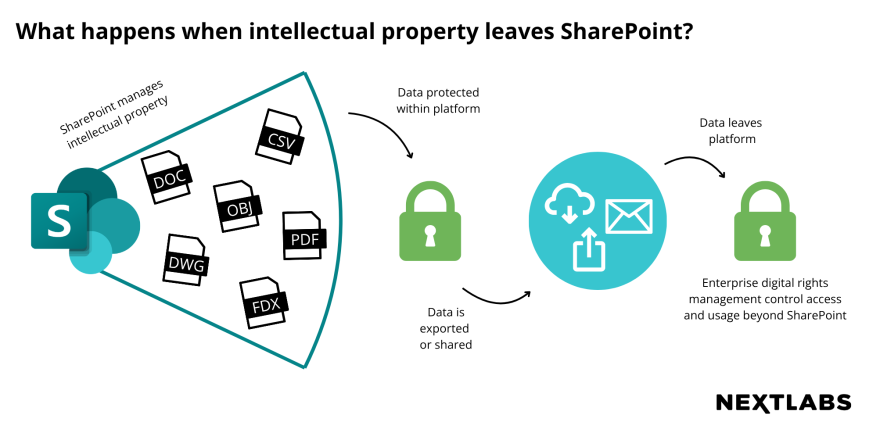
Many organizations manage highly valuable intellectual property in SharePoint, including engineering designs, financial data, pricing models, and strategic plans. Once a document is downloaded, shared, or emailed, native SharePoint controls no longer apply. Studies consistently show that users do not reliably protect sensitive information after it leaves the platform.
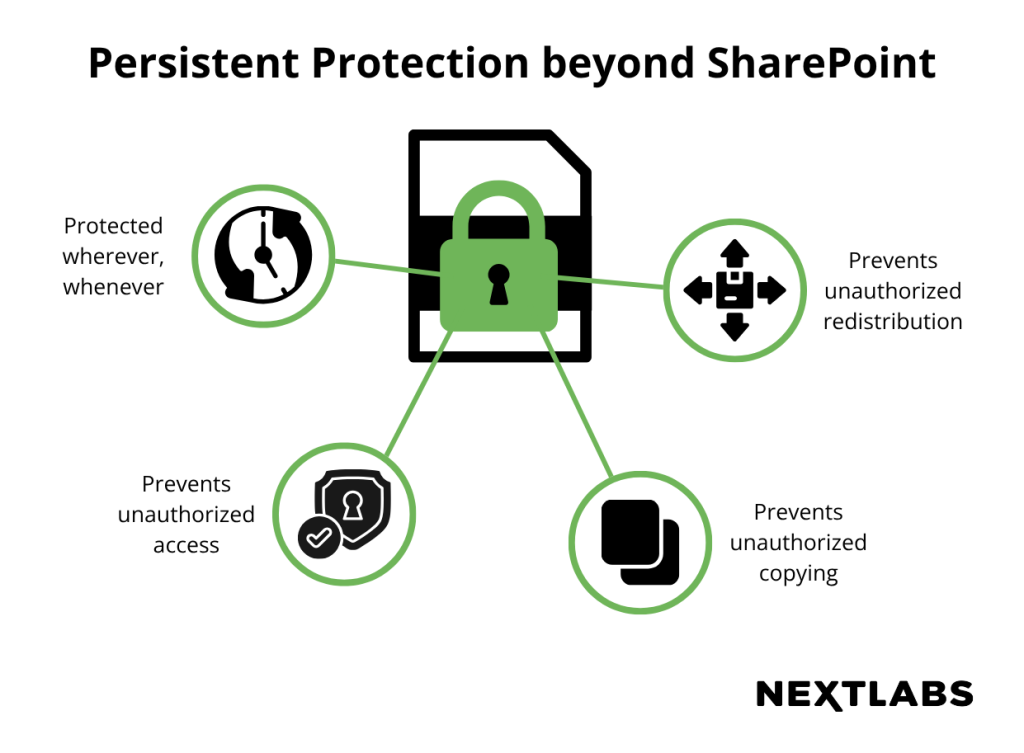
Persistent protection mechanisms such as enterprise digital rights management extend access and usage controls beyond SharePoint itself. These controls ensure that documents remain protected wherever they travel, preventing unauthorized access, copying, or redistribution even outside the organization.
Reducing Audit Complexity and Improving Visibility
As SharePoint usage expands, so does the cost and complexity of auditing. Organizations are expected to demonstrate compliance with regulations such as Sarbanes-Oxley, export control laws, and contractual obligations, even when SharePoint is used informally by business teams. Centralized policy management, automated auditing, and comprehensive reporting provide the visibility needed to satisfy auditors while reducing the operational burden on IT and compliance teams.
By aligning collaboration with information governance, organizations can use SharePoint for even their most sensitive business processes while maintaining control, compliance, and accountability.
Looking for a deeper dive into how organizations manage information risk on SharePoint without limiting collaboration? Read the Managing Information Risk for Microsoft SharePoint white paper to learn how data classification, attribute-based access control, and persistent protection work together to secure sensitive information and simplify compliance.
To comment on this post
Login to NextLabs Community
NextLabs seeks to provide helpful resources and easy to digest information on data-centric security related topics. To discuss and share insights on this resource with peers in the data security field, join the NextLabs community.
Don't have a NextLabs ID? Create an account.