

Enterprise Protection: Securing Data, Systems, and Business Continuity
In today’s digital landscape, enterprises face increasingly sophisticated cyber threats. Many organizations struggle to keep up, and data protection is often treated as an afterthought, despite being a non-negotiable priority. Ransomware, identity exposure, and supply chain vulnerabilities can disrupt operations, compromise sensitive data, and lead to financial and reputational damage. Robust enterprise protection minimizes these risks, strengthens organizational resilience, and helps ensures business continuity.
A proactive data protection strategy, supported by employee training to recognize threats like phishing, is essential for safeguarding company assets and driving growth.
What Enterprise Protection Means for Modern Organizations
Enterprise protection is a holistic cybersecurity approach that safeguards critical assets across cloud services, endpoints, remote workers, and third-party systems. Beyond technology, it includes policies, governance, and employee awareness to create a resilient security posture.
A dedicated security team oversees implementation, while compliance with regulations such as GDPR, HIPAA, and PCI DSS ensures legal adherence and operational continuity. Continuous monitoring and automated reporting strengthen enterprise readiness.
Understanding Threats
Modern enterprises face ransomware, malware, phishing, and other sophisticated cyber attacks. Weak passwords, unsecured networks, and untrained staff often create security vulnerabilities. Proactive measures, including robust security protocols, regular audits, and employee training, reduce the likelihood of breaches and minimize potential damage.
Strengthening Identity and Access Controls
Identity and Access Management (IAM) is central to enterprise protection. Multi-factor Authentication (MFA) and Single sign-on (SSO) enforce least-privilege access, limiting exposure to sensitive systems. Monitoring identity exposure helps prevent account takeovers and ransomware attacks.
Critical IAM practices include:
- Enforcing least-privilege access for all users
- Continuous monitoring for credential exposure and suspicious activity
- Robust logging to audit access and identity-related events
- Automated remediation integrated with systems like Active Directory, Entra ID, and Okta
Proactive IAM tools reduce response times from weeks to minutes and continuously monitor for risks.
Protecting Networks and Systems
Network security is foundational. Network segmentation prevents breaches from spreading, while firewalls, intrusion detection systems, and Endpoint Detection and Response (EDR) tools protect against unauthorized access. Secure connection protocols and streamlined authentication balance security with productivity.
Backup and recovery essentials:
- Disaster Recovery as a Service (DRaaS) ensures rapid restoration during ransomware attacks
- Immutable, encrypted, and air-gapped backups maintain business continuity
- Rapid recovery solutions allow operations to resume within minutes
Threat Intelligence and Data Practices
Threat intelligence enables proactive risk mitigation, while automation and orchestration streamline incident response and limit the impact of security incidents.
Data practices to reduce risk:
- Minimize collected data and automate deletion of excess records
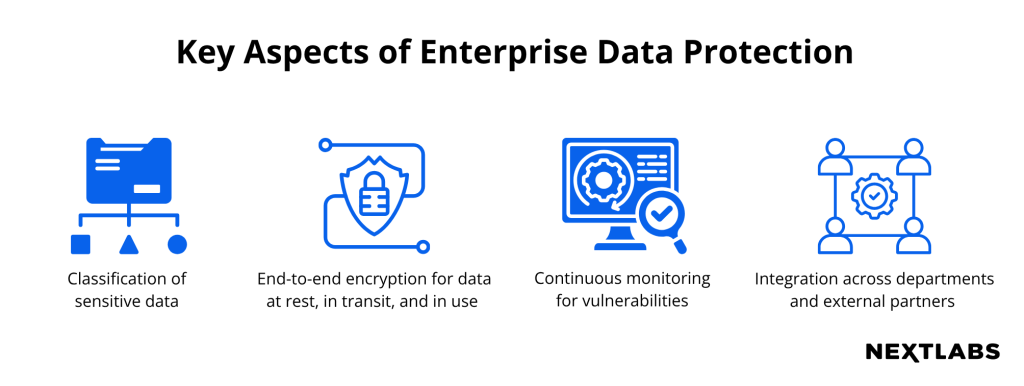
- Classify sensitive information across business units, partners, and applications
- Prioritize encryption early in the data protection process
- Regular audits and vulnerability testing ensure regulatory compliance
Enterprise AI tools, such as Microsoft 365 Copilot and Copilot Chat, fall under these protocols, with encryption and tenant isolation protecting user files and queries.
Governance, Third-Party, and Cloud Security
Enterprise protection extends beyond internal systems. Third-party risk management ensures that vendors meet security standards, contracts include security requirements, and continuous compliance monitoring is in place.
Cloud security requires verifying provider security protocols, implementing two-factor authentication, and monitoring applications for suspicious activity to reduce risks while enabling safe cloud adoption.
The Business Case for Enterprise Protection
Data breaches are increasingly costly, with the average breach cost projected at $4.88 million in 2024. A robust enterprise protection strategy:
- Protects sensitive data, systems, and user identities
- Improves regulatory compliance and reduces legal risk
- Accelerates incident detection and remediation
- Strengthens trust with customers, partners, and employees
A layered cybersecurity strategy, combining technical safeguards with policies and employee awareness programs, ensures rapid detection, response, and recovery from cyber threats while protecting critical operations.
Explore Zero Trust Data-Centric Security
To future-proof enterprise protection, many organizations are adopting Zero Trust Data-Centric Security, which focuses on securing the data itself rather than the network perimeter. By enforcing continuous verification, real-time access control, and activity monitoring, enterprises can protect sensitive information across cloud, on-premises, and hybrid environments. Learn more about this approach and how it strengthens enterprise protection here.
To comment on this post
Login to NextLabs Community
NextLabs seeks to provide helpful resources and easy to digest information on data-centric security related topics. To discuss and share insights on this resource with peers in the data security field, join the NextLabs community.
Don't have a NextLabs ID? Create an account.