Modern enterprises face two tightly linked access-control challenges: cloud entitlement sprawl and the need for dynamic, context-aware authorization decisions at runtime. Together, these forces expose a growing gap between how access is defined through entitlements and how it must be enforced through real-time authorization decisions.
PBAM and CIEM together are emerging as a unified approach to addressing this dual challenge, reducing structural access risk while enabling policy-driven authorization across complex environments.
Traditional authorization models are embedded within applications, resulting in fragmented enforcement and inconsistent policy implementation across systems. As environments expand across cloud and hybrid infrastructures, this model becomes increasingly difficult to scale or govern.
Modern authorization requires evaluation of contextual attributes such as identity context, device posture, and risk signals at runtime – capabilities that static application-bound models cannot reliably support.
This introduces several challenges:
Fragmented entitlement and authorization models
Runtime enforcement latency and scalability constraints
Policy sprawl and inconsistency across applications and environments
Legacy application incompatibility with externalized authorization
Limited ability to ingest and normalize real-time contextual signals
Immature policy governance and lifecycle management processes
PBAM addresses these challenges by externalizing authorization decisions from individual applications into centralized policy engines capable of evaluating access requests dynamically at runtime.
At the core of PBAM is the Policy Decision Point (PDP), which evaluates access requests in real time using attributes from Policy Information Points (PIPs), while Policy Enforcement Points (PEPs) enforce decisions within or adjacent to target systems. Policy definitions, often expressed in languages such as XACML or Rego, enable consistent and reusable authorization logic across environments.
This enables organizations to move toward dynamic, least-privilege authorization with just-in-time (JIT) access, aligned with Zero Trust principles and continuously evaluated contextual conditions.
Unified Authorization Model
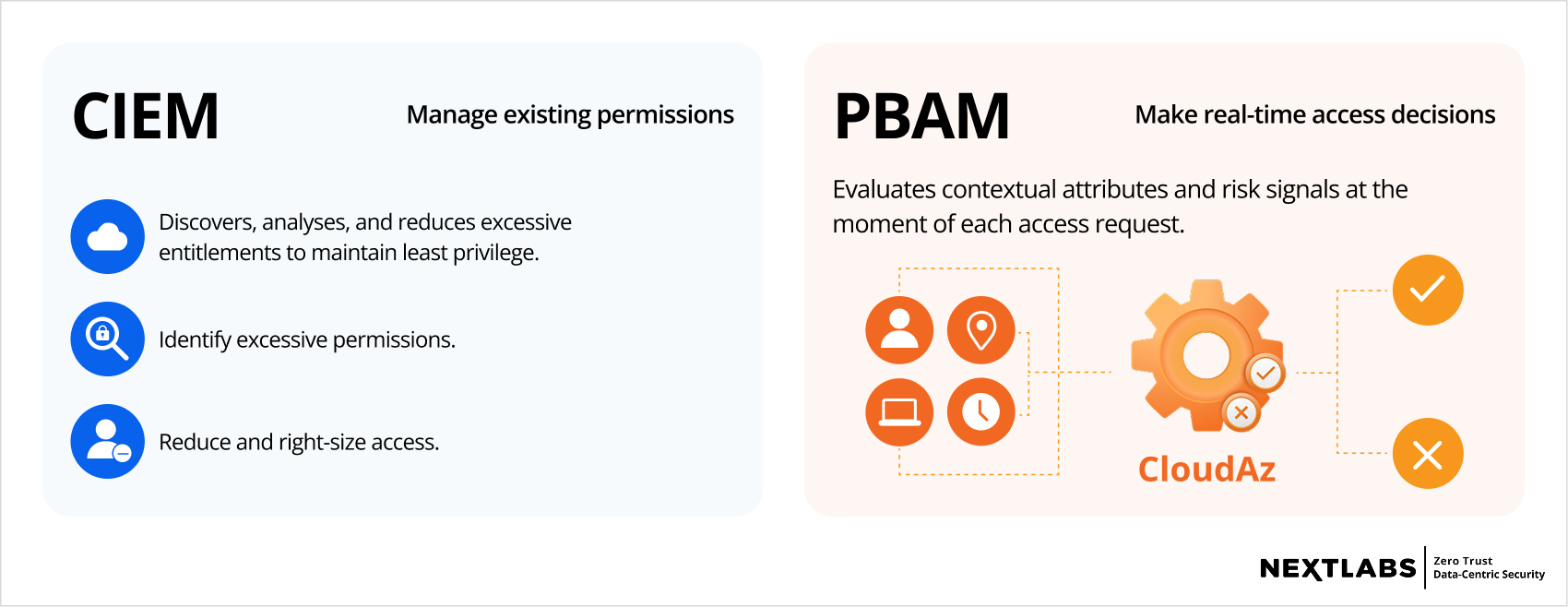
PBAM and CIEM address complementary layers of enterprise authorization. PBAM governs the runtime authorization layer, externalizing access decisions into centralized policy engines that evaluate contextual attributes and risk signals at request time. CIEM governs the structural entitlement layer, ensuring effective permissions are continuously discovered, analyzed, and reduced to maintain least privilege across environments.
Together, they form a unified authorization model that:
Reduces structural risk by governing and minimizing excessive entitlements
Enforces real-time, context-aware access decisions through centralized policies
This integrated approach closes the gap between entitlement governance and runtime authorization, enabling consistent enforcement of least privilege and Zero Trust-aligned access control across cloud, hybrid, and distributed environments.
Industry Direction and Platform Perspective
The convergence of PBAM and CIEM reflects a broader shift toward externalized, policy-driven authorization architectures.
Within this context, NextLabs is positioned across both domains with its CloudAz platform, which unifies entitlement governance and attribute-driven policy enforcement. Its architecture includes federated authorization, distributed enforcement with centralized governance, a Meta Attribute Store for attribute normalization, real-time attribute-based access control (ABAC) decisioning, broad enterprise integrations, and centralized audit and telemetry capabilities for visibility and compliance.
Access the Full Report
Learn more about how CIEM and PBAM work together to enable continuous authorization, enforce least privilege, and strengthen Zero Trust access governance across cloud and hybrid environments by accessing the full Buyer’s Compass on PBAM and CIEM, developed in collaboration with KuppingerCole Analysts.