

For years, enterprises have relied on Detect & Respond (D&R) strategies as the cornerstone of their cybersecurity defenses. By monitoring systems, detecting threats, and responding to incidents, D&R helps organizations contain damage once an attack has entered their environment.
But in today’s landscape of sophisticated, fast-moving cyber threats, reacting after the fact is no longer enough. Attackers are exploiting vulnerabilities faster, using automation themselves, and targeting sensitive data across global, interconnected systems. To keep up, enterprises need to do more than detect and respond — they need to prevent breaches before they happen and automate the repetitive tasks that slow security teams down.
That’s where Automate & Prevent (A&P) comes in. By extending D&R with Automate & Prevent, organizations can move from a reactive posture to a proactive, scalable, and intelligent security paradigm. The result? Reduced risk, faster response, and greater resilience in the face of today’s evolving threats.
Why Extend Detect & Respond?
Detect & Respond remains a critical element of modern security. It enables continuous monitoring, anomaly detection, incident investigation, and rapid containment. But it has three core limitations:
- It is reactive by design — assuming breaches will occur.
- It can be slow and resource-intensive, with analysts bogged down in manual triage.
It is hard to scale, especially in complex, global enterprises.
Enterprises can’t rely on D&R alone. Combining it with Automate & Prevent creates a stronger, more mature security framework that not only contains threats but also reduces the number of successful attacks in the first place.
This combined approach delivers four major benefits:
- Reduce risk: Fewer successful attacks mean less to detect and respond to.
- Save time: Automation frees analysts to focus on high-priority threats.
- Improve scalability: Policy-driven workflows scale without adding headcount.
Ensure consistency: Automated responses reduce human error and enforce standards.
The Evolved Paradigm: Prevent – Detect – Automate – Respond
Together, D&R and A&P form an evolved security model:
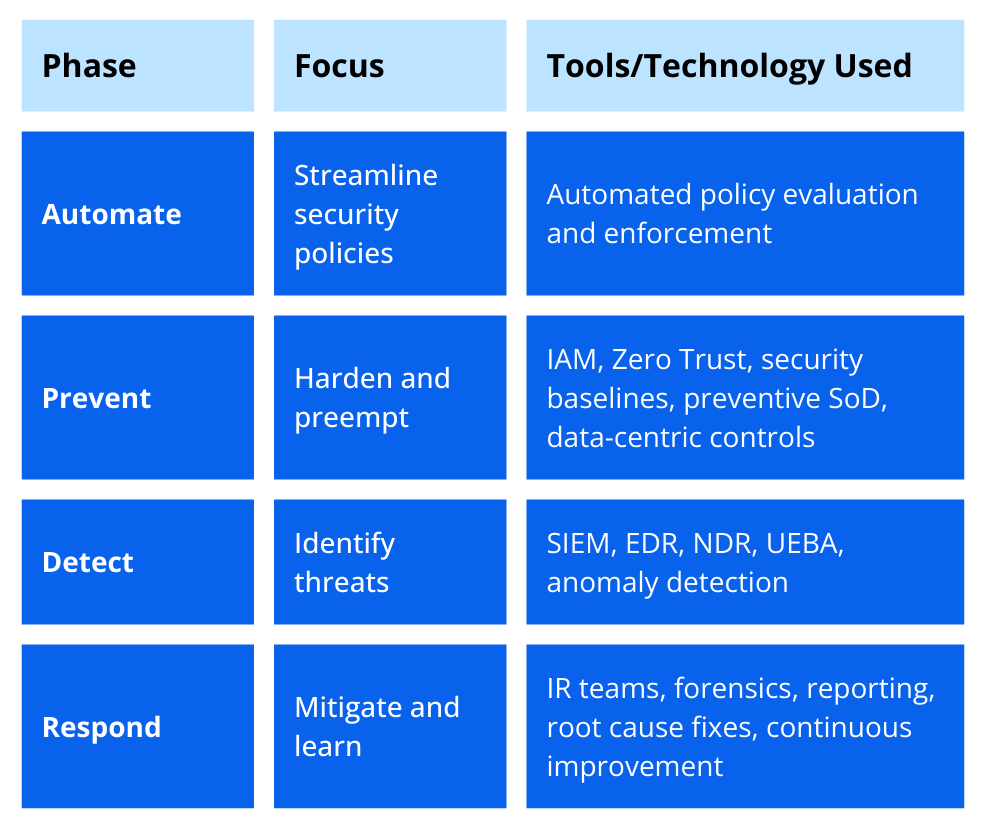
This model shifts security posture from reactive to proactive and intelligent, embedding controls earlier in the lifecycle and using automation to act at scale.
How Automate & Prevent Works
Prevention focuses on reducing the attack surface and stopping threats before they gain a foothold. Common strategies include:
- Enforcing least privilege access
- Applying multi-factor authentication (MFA)
- Managing vulnerabilities and patching software
- Educating users with security awareness training
- Applying Zero Trust Architecture principles
Think of it as locking the doors and windows, not leaving spare keys outside, and setting alarms to keep intruders out.
Automation ensures that once a threat is detected, the system can act immediately, reducing response time and analyst workload. Examples include:
- Auto-responding to known threats (block risky access, mask sensitive data)
- Auto-patching vulnerabilities
- Policy-driven enforcement (trigger MFA if suspicious behavior is detected)
- Orchestrating workflows across SIEM, SOAR, and EDR platforms
For example, if a user logs in from an unusual location, the system can automatically require MFA or block access. If a phishing email is detected, automation can remove it from all inboxes instantly.
Real-World Example: Boeing
The power of combining D&R with A&P is best seen in practice.
Boeing adopted NextLabs’ Zero Trust Data-Centric Security suite to secure its SAP S/4HANA environment and other enterprise applications. The implementation included:
- Attribute-Based Access Control (ABAC): Policies enforced least-privilege access based on user attributes.
- Data Protection Across Global Operations: Consistent data security across the U.S. and 65+ international sites, ensuring compliance with global regulations.
- Enhanced Security Posture: Consolidation of ERP systems with embedded security controls improved both efficiency and resilience.
By integrating Automate & Prevent, Boeing not only strengthened its security but also streamlined operations across a global footprint.
How NextLabs Helps
NextLabs extends D&R with Zero Trust Data-Centric Security to deliver Automate & Prevent capabilities:
- Dynamic Data Masking & Real-Time Protection — restrict access and secure sensitive data at rest and in use.
- Enterprise Digital Rights Management (E-DRM) — persistently protect files wherever they travel.
- Compliance Automation — ensure data access aligns with ITAR, EAR, and EH&S requirements.
Automated Policy Enforcement & Monitoring — reduce manual workload and enforce consistency across systems.
Moving Forward
The cybersecurity landscape is only getting more complex. Attacks are faster, more automated, and increasingly targeted at sensitive data.
Extending Detect & Respond with Automate & Prevent empowers organizations to:
- Shift left — embedding security earlier in the lifecycle.
- Reduce incident volume — by preventing more attacks outright.
Respond faster and smarter — with automation that scales.
By adopting this evolved paradigm, enterprises can build a more resilient, proactive, and intelligent defense posture.
To dive deeper, read the full solution brief: Automate & Prevent: Extending the Detect & Respond Paradigm
Or explore NextLabs’ Intelligent Enterprise page to see how Automate & Prevent can help safeguard your data and accelerate digital transformation.
To comment on this post
Login to NextLabs Community
NextLabs seeks to provide helpful resources and easy to digest information on data-centric security related topics. To discuss and share insights on this resource with peers in the data security field, join the NextLabs community.
Don't have a NextLabs ID? Create an account.