

Modern ERP Data Protection for Today's High-Risk Environment
August, 2025
August, 2025
Data is everywhere- and so are the threats. As cyberattacks grow more sophisticated and compliance demands become more complex, protecting ERP data at every stage of its lifecycle is no longer optional. Traditional perimeter-based security can’t keep up with today’s fast-moving, interconnected business operations. Without a practical, scalable security model, sensitive enterprise information remains exposed.
Read the latest whitepaper to discover practical steps for implementing a stronger and smarter data protection approach based on Zero Trust principle across ERP systems to enhance operational resilience, build stakeholder trust, and support secure digital transformation.
Modern enterprises seeking agility and scale need to consolidate disparate ERP systems to streamline operations, improve data visibility, reduce costs, and enable faster decision-making. However, managing disparate ERP instances to enforce access and compliance often leads to costly inefficiencies, data silos, and complex role structures. With global operations and external users now part of the equation, risks grow – leading to delays, role explosion, and security challenges that can derail consolidation effort.
Explore the newest solution brief to discover an advanced solution built natively for SAP solution that helps accelerate ERP consolidation by extending SAP authorization with attribute-based access control, eliminating role explosion with dynamic authorization, and enabling granular data-level security with field-level controls and data segregation.
As companies expand globally, nearshoring and offshoring have become essential strategies for driving cost efficiency, accessing specialized talent and scaling operations. In fact, 62% of manufacturing companies already leverage nearshoring as a competitive edge, while businesses across industries are expanding their offshore footprint. However, shifting operations across borders comes with new challenges – especially for data security, compliance, and governance – that traditional security approaches often fail to address.
This latest whitepaper breaks down five critical data security risks organizations must address when pursuing nearshore and offshore models. It also introduces a modern data-centric security solution that helps enforce consistent data access controls, streamline visibility, and maintain visibility across jurisdictions.
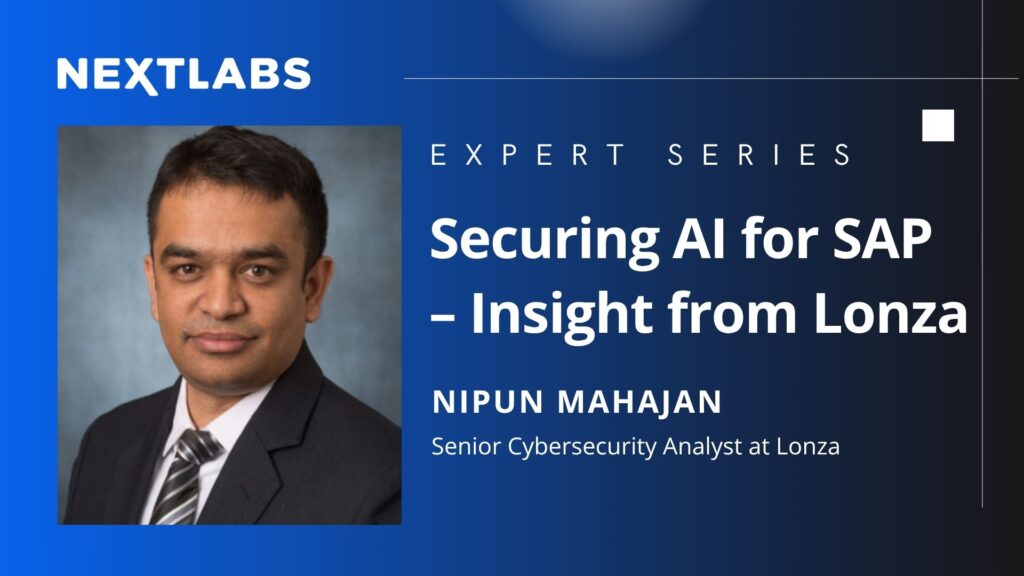
As enterprises increasingly integrate Artificial Intelligence (AI) into their SAP systems to become more intelligent, agile, and data-driven, they encounter a growing set of challenges: expanded attack surfaces, lack of visibility into AI-driven processes, and increased exposure of confidential business data. Without the right security strategy, the integration of AI into SAP could create significant vulnerabilities, putting critical business operations at risk.
In this newest episode of the NextLabs Expert Series, Nipun Mahajan, a Senior Cybersecurity Analyst at Lonza with over a decade of experience in the tech industry, unpacks the top challenges of securing AI for SAP. From increased attack surfaces to safeguarding confidential data, Nipun dives deeper into the real risks enterprises often encounter—and more importantly, how to mitigate them.
To comment on this post
Login to NextLabs Community
NextLabs seeks to provide helpful resources and easy to digest information on data-centric security related topics. To discuss and share insights on this resource with peers in the data security field, join the NextLabs community.
Don't have a NextLabs ID? Create an account.