

Rethink Data- Centric Security in a Perimeter-less Era
September, 2025
September, 2025
In today’s rapidly shifting digital landscape, the security and vulnerability of information are top concerns for every organization. Traditional network-centric security measures are falling short as data is stored and accessed across cloud services, remote work, IoT devices, and multi-cloud environments. This ever-expanding array of environment has made cyber risks harder to manage and IT infrastructure visibility more complex, creating new opportunities for attackers to access digital core assets. To address these challenges, organization must adopt a more resilient and adaptable security model – Zero Trust Data-Centric Security.
Read the white paper to learn more the advantages of a Zero Trust Data-Centric Security approach and how this zero trust-based model helps organization achieve greater flexibility, scalability, and control over their data, regardless of where it resides.
For years, traditional “Detect and Respond” (D&R) strategies have been known to help organizations identify and contain threats after they occur. However, in today’s dynamic, resource-intensive digital landscape, merely reacting post-incident is no longer sufficient. Attackers are quick to exploit vulnerabilities, automate their tactics, and target sensitive data across interconnected global systems – leaving dangerous data security gap when relying solely on D&R. To bridge these gaps, organizations need to enhance D&R with Automate & Prevent (A&P) – a scalable and proactive approach that automates security controls and prevent threats before they happen.
Read the solution brief to dive deeper into how extending D&R with Automate & Prevent enhances the maturity, scalability, and proactiveness in organization’s cybersecurity operations and explore a real-world implementation from Boeing.
As organizations race to harness AI’s potential, they are increasingly drawing on large, diverse datasets that often include regulated records, intellectual property (IP), trade secrets, and personally identifiable information (PII). Protecting this sensitive data is critical – not only for compliance but for safeguarding innovation, trust, and business integrity. However, AI environments often incorporate broad access to data by multiple roles, which complicates governance and increase vulnerability to misuse, data leaks or cyberattacks. To mitigate these risks, organizations need a stronger defense-in-depth strategy that secures not just access but also how data is stored, handled, and governed through the AI lifecycle.
Read the article to explore best practices for protecting sensitive data in AI Model and learn why Zero Trust Security is recognized as one of the reliable security frameworks for protecting confidential information while enhancing organizational resilience in today’s complex AI era.
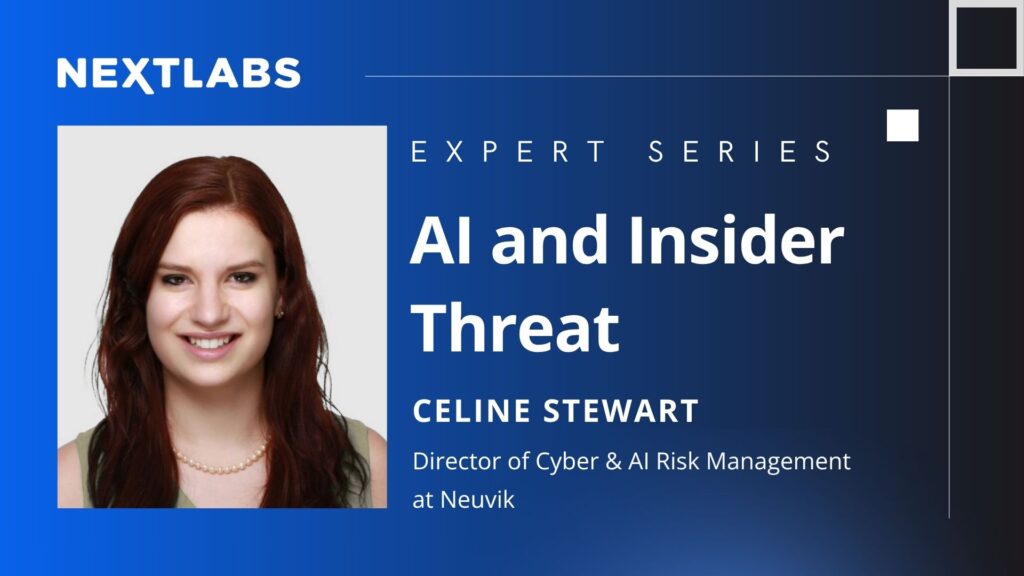
AI has profoundly changed the way organizations operate, but it has also made it easier for malicious insiders to pose risks to businesses. Disgruntled employees responsible for “training” AI tools can distort baselines, making malicious activity to appear normal. Those intent on corporate espionage or profiting from the unauthorized sale of intellectual property (IP) can use Computer Vision or Optical Character Recognition (OCR) to extract and replicate data sets without consent. If these critical risks are not adequately managed, organizations may confront serious threats to their intellectual property, customer trust, and regulatory compliance.
NextLabs’ Expert Series on AI and Insider Threats is a two-part video series. Previously, in Part 1, Celina Steward, Director of Cyber Risk Management at Neuvik explains how AI contributes to insider threats, including risks from the Corpus Generation process and the danger of bad artifacts. Part 2 builds on this foundation, diving deeper the Computer Vision, the role of Complacency, along with strategies to mitigate these risks when leveraging AI technologies.
To comment on this post
Login to NextLabs Community
NextLabs seeks to provide helpful resources and easy to digest information on data-centric security related topics. To discuss and share insights on this resource with peers in the data security field, join the NextLabs community.
Don't have a NextLabs ID? Create an account.