The aerospace and defense industry relies on global collaboration to accelerate product development, manufacturing, maintenance, and innovation. Organizations routinely share sensitive technical data with suppliers, contractors, manufacturing partners, and government agencies across multiple countries. While this collaboration improves efficiency, it also increases the risk of unauthorized access, intellectual property (IP) theft, data leakage, and regulatory non-compliance.
From engineering drawings and CAD files to product specifications and export-controlled technical data, organizations must protect critical information throughout its lifecycle while complying with regulations such as ITAR, EAR, DFARS, and CMMC without disrupting business operations. As supply chains become increasingly interconnected and engineering teams collaborate across multiple organizations, implementing effective data security has become essential for safeguarding sensitive information while enabling secure collaboration.
Why Data Security Matters in Aerospace & Defense
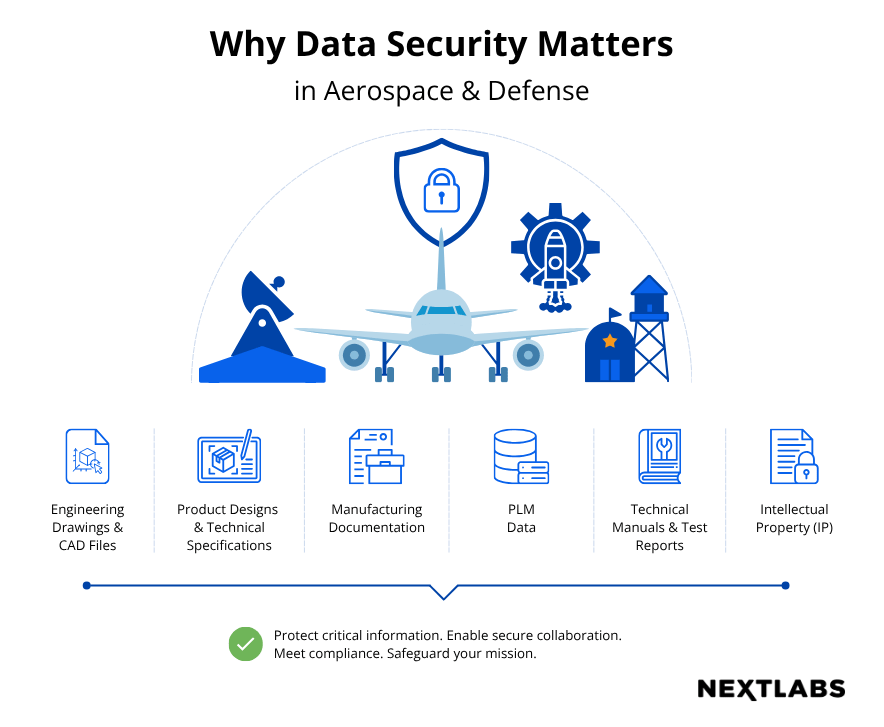
Aerospace and defense organizations manage a wide range of sensitive information throughout the product lifecycle, including:
Engineering drawings and CAD files
Product designs and technical specifications
Manufacturing documentation
Product Lifecycle Management (PLM) data
Technical manuals and test reports
Proprietary research and intellectual property (IP)
Protecting this information while enabling secure collaboration has become increasingly important as organizations work across global supply chains while meeting evolving regulatory and contractual requirements.
Key Data Security Challenges
Export-Controlled Technical Data
Technical data frequently moves across international teams, suppliers, and project partners. Without appropriate controls, organizations risk unauthorized disclosure of export-controlled information, regulatory violations, and costly project delays.
Engineering drawings, CAD files, product designs, manufacturing processes, and research data represent valuable intellectual property. As organizations collaborate across PLM systems and external supply chains, protecting intellectual property from unauthorized access and accidental disclosure becomes increasingly important.
Organizations also need to maintain control over sensitive product data after it leaves its original system. A secure collaboration strategy for PLM can help protect engineering information as it is shared among internal teams, suppliers, contractors, and other external partners.
Data Loss Prevention
Sensitive information can be exposed through email, cloud storage, removable media, collaboration platforms, or unauthorized file sharing. Preventing data loss requires organizations to apply consistent protection policies that help secure information both inside and outside the corporate network.
These controls should address how sensitive information is accessed, copied, downloaded, transferred, and shared without unnecessarily restricting legitimate business activities.
Why Traditional Security Isn't Enough
Traditional security approaches primarily focus on protecting the network perimeter. However, aerospace and defense organizations increasingly operate across cloud environments, remote workforces, outsourced manufacturing, and globally distributed supply chains where sensitive information regularly moves beyond traditional security boundaries.
Once information leaves an application or network, conventional security controls may no longer provide sufficient protection. Organizations require security that remains with the data itself, helping ensure sensitive information is protected wherever it is stored, accessed, or shared.
Protect export-controlled technical data throughout its lifecycle
Secure engineering drawings, CAD files, and technical documentation
Restrict data access to authorized users based on identity and business policies
Strengthen intellectual property protection across PLM and engineering workflows
Support export control compliance and information governance
Reduce data loss risks across internal teams and external partners
Enable secure collaboration throughout the global aerospace and defense supply chain
Improve visibility through centralized auditing and monitoring
Rather than relying solely on network-based security, data-centric security applies protection directly to the information itself, helping organizations safeguard sensitive data wherever it is stored, accessed, or shared.
Organizations can also use attribute-based access control (ABAC) to make fine-grained access decisions based on factors such as user identity, project, security clearance, data classification, location, and business context. Centralized auditing and reporting provide greater visibility into how sensitive information is accessed, shared, and used, supporting compliance and strengthening overall information governance.
Learn More About Aerospace & Defense Data Security
Protecting export-controlled technical data, intellectual property, and sensitive engineering information requires a comprehensive security strategy that balances compliance with collaboration.
Download the NextLabs Aerospace & Defense Solution Brief to learn how organizations can protect export-controlled technical data, strengthen intellectual property protection, support export control compliance, reduce data loss risks, and enable secure collaboration across the global aerospace and defense supply chain.