

Home | Intelligent Enterprise | Data-Centric Security |
Software Development Life Cycle (SDLC): A Structured Framework for Secure and High-Quality Software
What is Software Development Life Cycle (SDLC)
Software Development Life Cycle (SDLC) is a structured, iterative methodology used by software organizations to plan, design, develop, test, deploy, and maintain high-quality software applications and software projects. The SDLC methodology provides a systematic approach that guides teams through each phase of the software development process, ensuring that project scope, requirements, and risks are effectively managed. Various software development models within the SDLC provide structured frameworks for managing the entire process, from initial planning to deployment and maintenance. The SDLC promotes transparency through standardized documentation and clear communication channels, helping teams align on goals, timelines, and requirements. By setting clear expectations for scope, timelines, and deliverables, the SDLC fosters collaboration across stakeholders.
For modern enterprises, the SDLC is more than a development model—it is a governance mechanism that supports predictable delivery, security integration, and long-term software quality. The SDLC provides a map that helps teams complete complex software development projects within defined time frames and cost estimates.
Why the SDLC Matters in Software Development Projects
The SDLC provides a structured and repeatable approach to software development projects, particularly in environments with multiple stakeholders, regulatory requirements, and distributed development teams.
Key Benefits of the SDLC
- Provides a clear roadmap for completing complex software development projects within planned time frames and budgets
- Helps stakeholders estimate project costs, timelines, and resource needs
- Promotes transparency through standardized documentation and open communication
- Encourages collaboration among developers, testers, project managers, and end-users
- Helps identify potential challenges and address risk factors early in the development lifecycle
By eliminating guesswork, the SDLC enables organizations to align technical execution with business and security objectives.
Project Scope in the SDLC
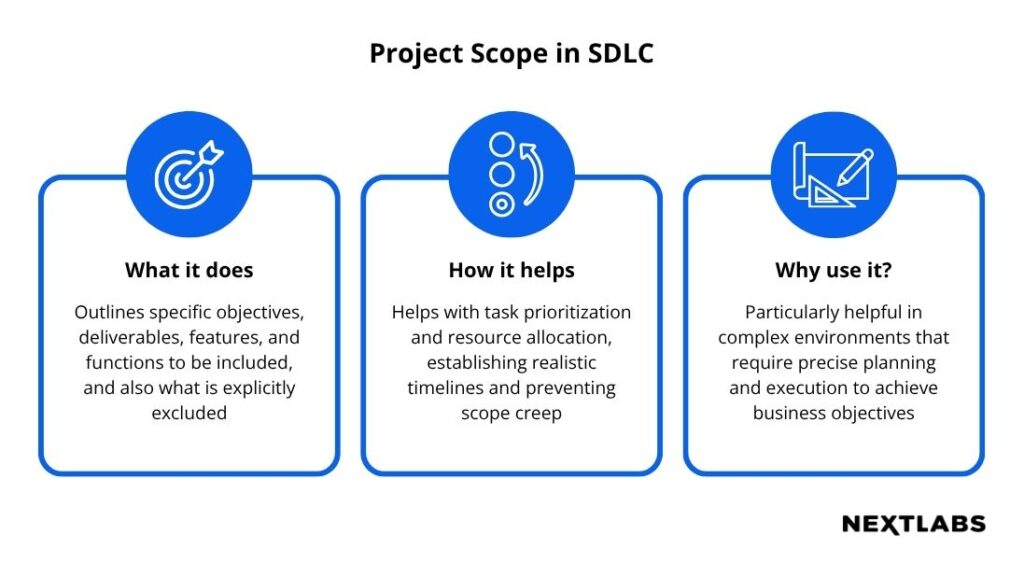
Defining the project scope is a foundational step in the Software Development Life Cycle (SDLC) that sets the boundaries for what the development team will deliver. During the planning phase, the project scope outlines the specific objectives, deliverables, features, and functions that the software must include, as well as what is explicitly excluded . This clarity is essential for guiding the entire development process and ensuring that all stakeholders share a common understanding of the project’s goals.
A well-articulated project scope helps the development team prioritize tasks, allocate resources efficiently, and establish realistic timelines. By detailing both functional and non-functional requirements, user interface expectations, and any technical constraints, the scope acts as a blueprint for creating high-quality software that aligns with customer expectations. It also serves as a reference point throughout the development life cycle (SDLC), helping to prevent scope creep—unplanned changes that can lead to missed deadlines, increased costs, and reduced software quality.
Ultimately, a clear project scope empowers the development team to stay focused, track progress, and deliver software that meets the defined requirements. This structured approach is vital for successful software development projects, especially in complex environments where precise planning and execution are critical to achieving business objectives.
Seven Key Phases of the Software Development Life Cycle
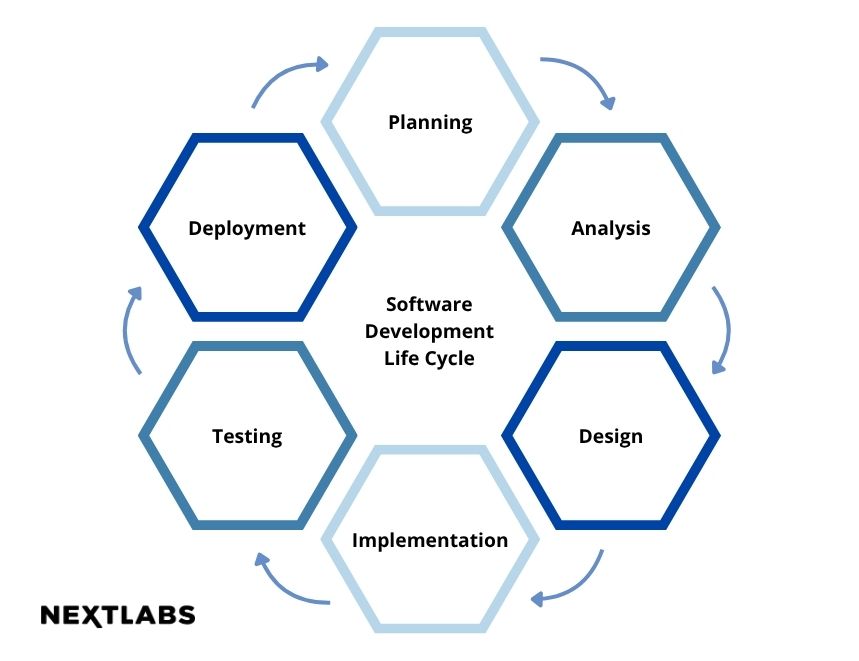
The SDLC is commonly divided into seven key phases that guide the development process from initial concept through long-term support.
Planning Phase
The planning phase establishes the goals, constraints, and scope of a software development project. It defines timelines, budgets, dependencies, and success criteria while including early risk assessment, risk management, and risk analysis—a key activity for evaluating technical and financial viability and identifying potential challenges during the planning phase.
Analysis Phase
During the analysis phase, the development team collects and analyzes detailed information on the project’s requirements, often through an iterative process of stakeholder engagement and refinement. This ensures that business needs, technical feasibility, and compliance considerations are clearly understood before design begins.
Design Phase
The design phase involves defining the project’s software architecture and creating a technical blueprint for the solution. Design decisions made here influence performance, scalability, maintainability, and security throughout the entire process.
Development Phase
The development phase is where the actual coding takes place based on the design specifications. Continuous integration is used to automate code integration, support ongoing testing, and improve code quality as new changes are introduced . Software developers and software engineers implement functionality, apply version control, conduct code reviews, and follow secure coding standards to improve code quality.
Security best practices are applied during the implementation phase, with a focus on developing secure code and reducing the introduction of vulnerabilities.
Testing Phase
The testing phase is critical for identifying and fixing defects before the software is deployed to users. Testing activities commonly include:
- Unit testing
- Integration testing
- System testing
- User acceptance testing
- Security testing and penetration testing
- Security assessments, including vulnerability scanning and security audits
Security assessments help identify and address security threats throughout the SDLC.
Rigorous testing and quality assurance practices help ensure that software meets functional, performance, and security requirements. Regular security checks within the (CI/CD) pipeline can preemptively address vulnerabilities, reducing the likelihood of security issues in the final product.
Deployment Phase
The deployment phase involves releasing the software to end-users after testing is complete. Controls and validation steps help ensure that the application performs as expected in the production environment.
Maintenance Phase
The maintenance phase includes ongoing support, updates, and improvements after deployment. This phase is essential to maintain software quality and security over time. Teams monitor performance, fix bugs, address security vulnerabilities, and introduce new features as business needs evolve.
Integrating Security Throughout the SDLC
Modern organizations increasingly require that the SDLC address security as a continuous responsibility rather than a final-stage checkpoint, embedding security practices throughout every phase across planning and development to testing, deployment, and maintenance to proactively identify and mitigate risks while ensuring high-quality, compliant software delivery.
DevSecOps and Secure SDLC
DevSecOps integrates security practices into every stage of the software development lifecycle (SDLC). Security is integrated throughout the entire SDLC, from build to production, rather than isolated in the testing phase.
In a DevSecOps environment:
- Security testing becomes a continuous process throughout the SDLC
- Regular security checks within the CI/CD pipeline can preemptively address vulnerabilities
- Automated testing tools and static code analysis help identify issues early
- Continuous security monitoring and testing allow teams to remediate threats before they escalate
This approach helps mitigate security risks at every stage by embedding security measures directly into the development process.
SDLC Models and Software Development Methodologies
Different SDLC models support different delivery styles, risk profiles, and project requirements. Traditional software development commonly follows a linear, sequential approach with extensive planning and defined phases, in contrast to more modern, iterative approaches like Agile and DevOps, which emphasize flexibility and continuous improvement. The SDLC is a structured software development process that guides projects from initial planning through deployment and ongoing maintenance, ensuring quality, security, and efficiency throughout the software lifecycle.
For example, the Big Bang model is an informal and unstructured form of software development that lacks the rigorous definition of models normally associated with the SDLC.
Common and Popular SDLC Models
- Waterfall model – A linear and sequential approach where each phase must be completed before the next begins, best suited for fixed requirements
- V-Model – An extension of Waterfall where testing is planned in parallel with development phases to ensure verification and validation
- Agile model – An iterative and collaborative approach emphasizing rapid development cycles, customer feedback, and continuous improvement
- Scrum – A subset of Agile that uses fixed-length sprints and defined roles such as Scrum Master and Product Owner
- Kanban – Focuses on continuous flow and visualizing work to manage work in progress
- Iterative model – Develops a basic version first and refines it through multiple development cycles
- Spiral model – Combines elements of the iterative model and risk management, making it suitable for high-risk, complex projects
- Lean model – Applies manufacturing principles to reduce waste and optimize efficiency across the SDLC
- RAD (Rapid Application Development) – Relies on fast prototyping and user feedback rather than extensive upfront planning
- Big Bang model – An informal and unstructured approach with minimal planning and high risk
Common SDLC models include Waterfall, Agile, and DevOps, each offering different trade-offs between flexibility, control, and predictability.
Agile, DevOps, and Risk Management in the SDLC
Agile emphasizes iterative development and customer collaboration, breaking work into small, manageable sprints. Agile and DevOps allow for changes throughout the SDLC, while Waterfall and V-Model tend to lock requirements early.
The Spiral model is designed specifically to mitigate risks early, while Agile manages risk by frequently delivering functional components and incorporating feedback.
DevOps is a software development methodology that combines and automates the work of software development and IT operations teams, improving deployment speed and reliability.
SDLC as a Foundation for Quality, Security, and Governance
The SDLC helps ensure a structured and repeatable approach to creating high-quality software that meets stakeholder and end-user needs. By incorporating risk management, rigorous testing, and integrated security, the SDLC supports:
- Predictable project management and delivery
- Strong collaboration across teams
- Improved software quality and maintainability
- Secure handling of sensitive data
- Scalable solutions adaptable to changing requirements
Ultimately, the Software Development Life Cycle (SDLC) provides a disciplined framework that helps organizations operate efficiently while producing secure, reliable, and high-quality software.
Enhancing SDLC Security with NIST SSDF, Zero Trust, and PBAC
Modern SDLC practices go beyond planning, coding, and testing—they require embedded security throughout the lifecycle. NextLabs aligns with the NIST Secure Software Development Framework (SSDF), applying Zero Trust and data-centric security with policy-based access control (PBAC) to protect code, data, and operations at every phase.
Organizations using these practices can:
- Secure source code, build processes, and test environments
- Enforce least-privilege access and continuous verification
- Mitigate insider threats and third-party risks
- Integrate AI for adaptive monitoring and policy enforcement
This approach operationalizes security as a core part of SDLC, ensuring compliance, resilience, and secure software delivery.
FAQ
Is SDLC still relevant today?
Yes. Modern SDLCs remain essential for governance, risk management, and integrating security into Agile, DevOps, and cloud-based development environments.
What is the SDLC waterfall model?
The Waterfall model is a linear SDLC approach where each phase is completed sequentially, making it suitable for projects with fixed requirements and strict compliance needs.
What is the SDLC in Agile?
The SDLC in Agile applies iterative development, breaking work into small sprints that deliver functional software quickly. It emphasizes collaboration, continuous feedback, and integrated security throughout the lifecycle.
What is DevOps vs SDLC?
DevOps is a methodology that automates development, testing, and deployment to accelerate delivery. SDLC is the structured framework guiding all phases of software creation. DevOps complements the SDLC by streamlining processes and embedding security and quality controls across the lifecycle.
Which is better, Agile or Waterfall?
Agile is ideal for projects requiring flexibility, rapid delivery, and continuous feedback. Waterfall suits projects with fixed requirements and strict compliance needs. The “better” approach depends on project complexity, risk profile, and stakeholder expectations.
NextLabs Resources






- Introduction
- What is Software Development Life Cycle (SDLC)
- Why the SDLC Matters in Software Development Projects
- Project Scope in the SDLC
- Seven Key Phases of the Software Development Life Cycle
- Integrating Security Throughout the SDLC
- SDLC Models and Software Development Methodologies
- Agile, DevOps, and Risk Management in the SDLC
- SDLC as a Foundation for Quality, Security, and Governance
- Enhancing SDLC Security with NIST SSDF, Zero Trust, and PBAC
- FAQ
- Resources