Enterprises are undergoing a transformation as more move from processes where humans drive every workflow to one where AI agents execute complex, multi-step tasks autonomously. It is not an incremental evolution, but rather a fundamental shift, and it demands re-evaluation of enterprise security architecture.
The Problem: Static Access Control Was Built for Yesterday
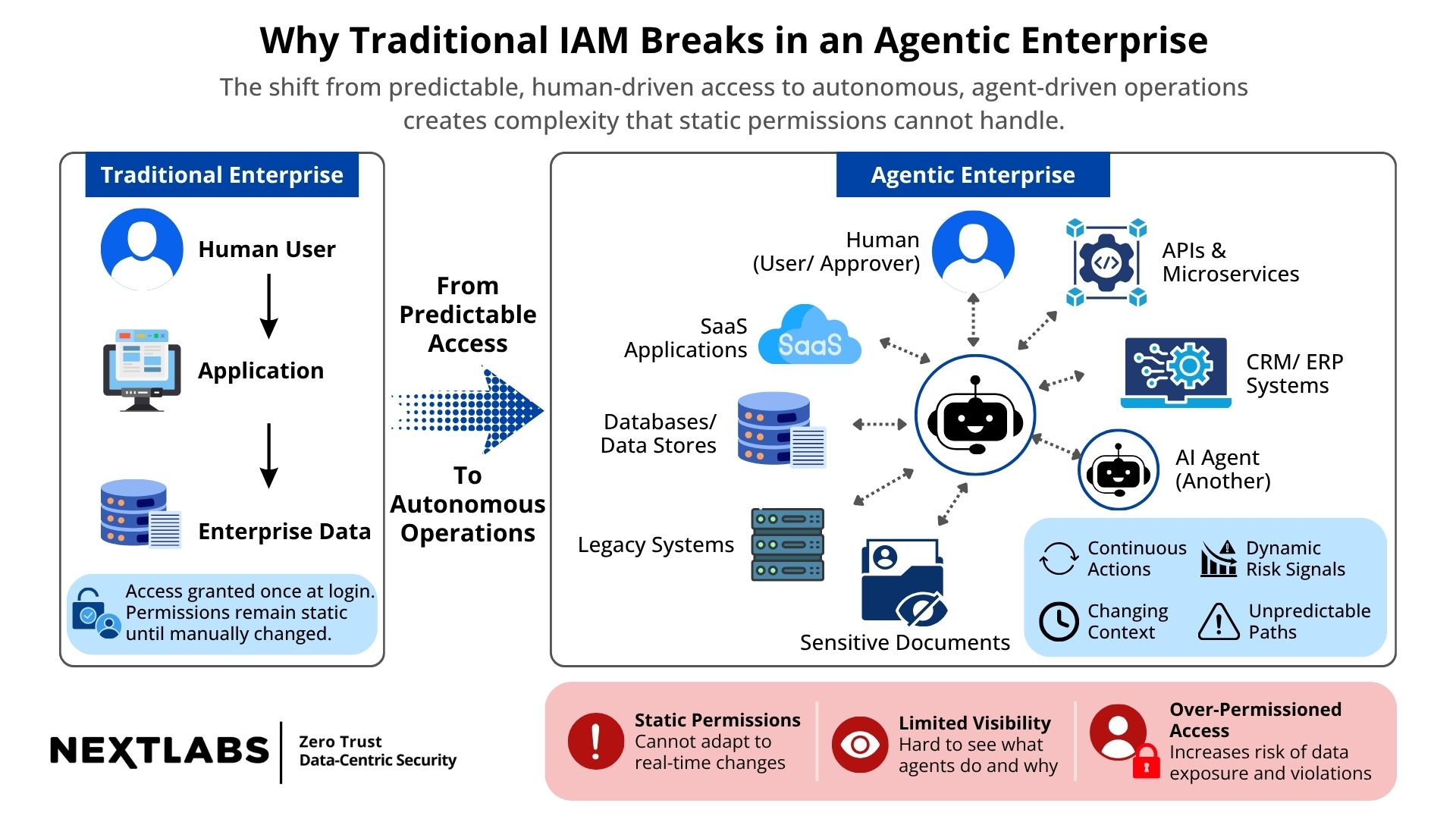
Traditional Identity and Access Management (IAM) models were designed for human users, static roles, and predefined applications. They operate on two assumptions: access decisions can be made once at login, and that permissions remain valid until revoked.
In an agentic AI world, those assumptions no longer hold.
AI agents can act continuously and autonomously, chaining actions across systems in ways that were never anticipated. Context shifts in real time, user intent changes, data sensitivity fluctuates, and risk signals emerge without warning. Delegation of authority becomes dynamic and often opaque.
Consequences are often severe, with over-permissioned agents, no visibility into why actions were taken, and an increased risk of data exfiltration and compliance violations. The tools that served well for human-centric security are no longer adequate.
The Shift from Access Control to Decision Control
NextLabs is at the forefront of reshaping the cybersecurity conversation around the core principles of Zero Trust: least privilege access and the philosophy of “Never Trust, Always Verify”. Security must move beyond static access controls to continuous, context-aware, and dynamic authorization of every action. As data flows across users, applications, AI agents, and cloud environments, trust must be earned and validated at every step, ensuring that access decisions remain aligned with business risk, compliance requirements, and real-time context.
For example: traditional access control asks, “Can you enter the building?” Dynamic Authorization asks, “Can you enter the building at 6pm to retrieve a confidential document in Room 212?”. This is a fundamental shift, security moves from a single checkpoint to continuous, intelligent evaluation with every interaction, taking accounts of contextual attributes in addition to identities.
Dynamic Authorization: The Control Layer for Agentic AI
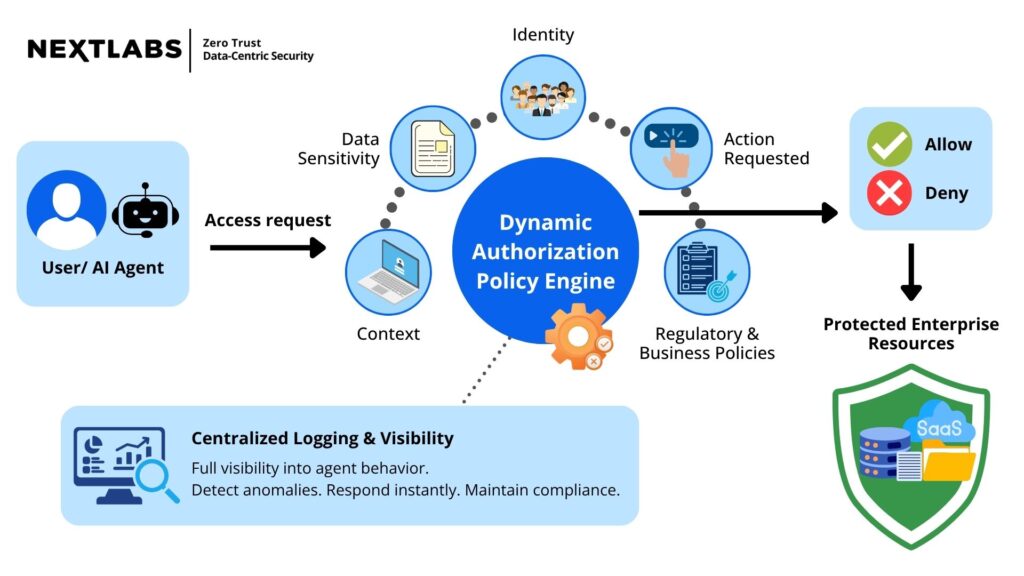
Dynamic Authorization is powered by a policy-driven, real-time authorization engine that evaluates every request dynamically. Instead of static roles or pre-assigned permissions, it considers a rich set of attributes for every access request, including:
The identity of the user or agent
The sensitivity and classification of the data
The specific action being attempted
The context, including location, device, risk posture, and purpose
The regulatory and business policies that govern the interaction
Access requests are evaluated in real-time with contextual attributes, so even if an AI agent manages to get within the enterprise perimeter, sensitive data remains out of reach. Policies protect the data itself, not just application boundaries, ensuring consistent enforcement whether an agent is interacting with SaaS platforms, legacy systems, or other AI agents. Because every authorization decision is centrally logged, security teams gain full visibility into agent behavior, enabling them to detect anomalies, respond to emerging threats instantly, and maintain compliance, all without slowing down autonomous operations.
Core Capabilities of Dynamic Authorization
Fine-grained, context-aware policy enforcement: Policies adapt in real time as context changes, enabling the enforcement of least privilege for each access request.
A data-centric approach: Policies protect the data, not just the application. This ensures consistent enforcement across SaaS platforms, APIs, and AI agent workflows. Wherever the data goes, the policy goes with it.
Secure delegations for AI agents: Policies govern “acting on behalf of” relationships, ensuring agents operate within explicit scope, approved intent, and time-bound permissions. This prevents privilege escalation in multi-agent environments.
Continuous authorization: Every action is evaluated in real time based on changing risk signals in accordance with Zero Trust principles.
Full visibility and auditability: Every access request and decision is centrally logged. This builds trust in autonomous systems and enables robust compliance and forensics.
Business Value
The impact of implementing Dynamic Authorization is tangible and immediate. Risk shrinks dramatically as over-permissioned access is eliminated and unauthorized data movement is blocked in real time. AI adoption accelerates because security teams can confidently deploy autonomous agents with controlled, policy-bound autonomy, innovation no longer comes at the cost of governance. Compliance becomes automated and auditable, with policies enforced dynamically across jurisdictions and data types, eliminating manual errors that can result from static models. Operations speed up as manual approvals are replaced with policy-driven, instant decisions. Security no longer slows the business down, it becomes the engine that enables safe, rapid digital transformation.
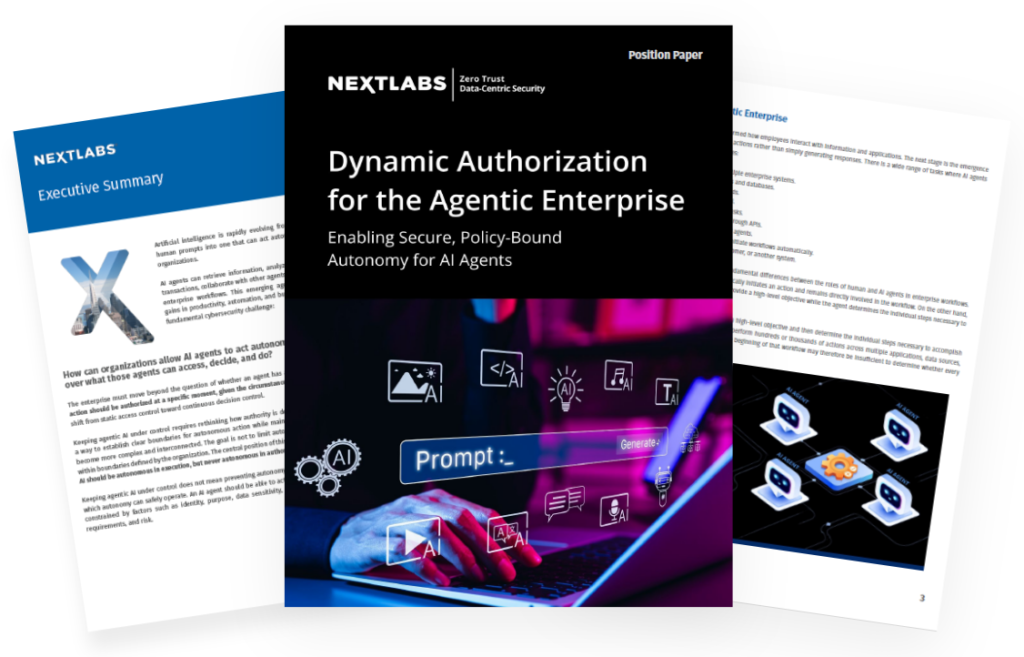
Download the full Position Paper
Explore in full details about the control challenges in agentic enterprises, the imperative to redraw boundaries around data, and how Dynamic Authorization secures agentic enterprises.