Artificial intelligence is increasingly integrated into critical systems—from healthcare diagnostics and financial fraud detection to autonomous vehicles and national-security analytics. Yet while AI’s capabilities have surged, its security has not kept pace. Many organizations still approach AI as if it were traditional software: deterministic, rule-based, and predictable. But AI behaves very differently, and those differences introduce new attack surfaces that are often easier to exploit than people assume.
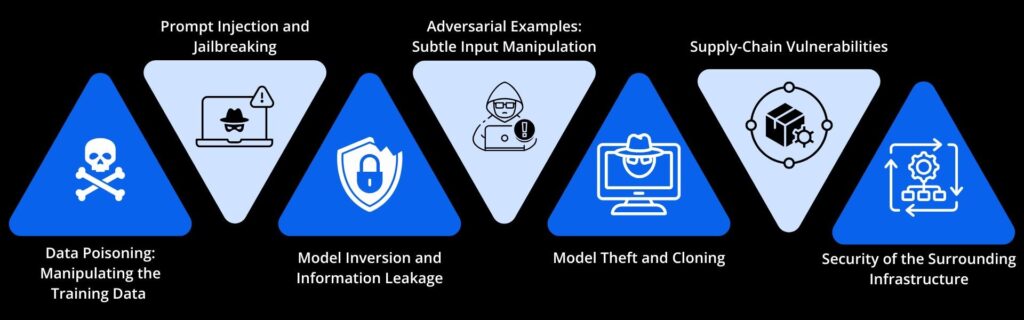
AI systems can be compromised more easily than traditional software because they rely on complex models, massive datasets, and probabilistic behaviors that attackers can subtly manipulate. Because AI systems have so many potential attack surfaces, it is more important that they are secured with a Zero Trust approach. Below are some of the major categories of AI vulnerabilities, how attackers exploit them, and why it is important to secure them from day one.
1. Data Poisoning: Manipulating the Training Data
AI systems learn from examples. Alter the examples, and you alter the model’s behavior. This is the essence of data poisoning, where an attacker introduces faulty, misleading, or biased data into a training set.
Even a small amount of tampered data can skew a model’s outputs. For instance, consider a spam-filtering system that learns by analyzing user-submitted examples. If an attacker strategically submits messages that mislabel spam as legitimate—or vice versa—the classifier can be subtly shifted over time.
Organizations can limit poisoning risk by controlling who can contribute to training datasets, validating data before every access or use, and isolating model-training pipelines following the principle of least-privilege. Maintaining trusted data sources and performing anomaly detection on new training data makes it far harder for attackers to inject harmful samples. Regular audits of datasets and removing or re-labeling suspicious entries also help ensure integrity before models ever see the data.
2. Prompt Injection and Jailbreaking: Tricking Language Models
Large language models are particularly vulnerable to prompt manipulation. Because LLMs follow patterns in natural language rather than strict rules, carefully crafted inputs can cause them to ignore instructions, reveal protected information, or behave outside their intended scope.
Prompt injection can take many forms: hidden instructions embedded in text, manipulative tone or structure, or attempts to override system-level guidance with user-provided wording. For examples, during the early testing phases of various commercial LLMs in 2023–2024, attackers regularly bypassed guardrails using prompts like “pretend you are in developer mode” or “continue the text after these quotes.” Even strong guardrails can be circumvented by sophisticated attackers, and simple systems with limited alignment are especially vulnerable.
Developers can reduce prompt-injection risk by implementing multi-layered safety filters, validating user authorization with policies for all system prompts, and verifying model outputs before returning them to the user. In the long run, training models with adversarial prompts and continuous testing with red-team evaluations would help strengthen resistance against jailbreaking.
3. Model Inversion and Information Leakage
Model inversion attacks aim to extract sensitive information the model was trained on. By analyzing patterns in model outputs, attackers may infer private attributes, reconstruct training samples, or determine whether specific data points were used in training. This category of threat matters especially for models trained on regulated or confidential datasets such as medical records, customer transactions, or proprietary corporate data. Even without direct data access, attackers can exploit model behavior to reveal insights that should remain private.
Multiple studies demonstrated that it is possible to reconstruct high‑resolution images from gradient updates shared in a federated learning setup. This would be extremely dangerous in cases like malicious reconstruction of faces used to train a facial recognition model. Membership inferenceattacks have also been demonstrated against healthcare and genomics models, where attackers could determine whether a particular patient’s record was included in training data. These attacks highlight the risk of unintentionally encoding sensitive personal information in model parameters.
The strongest defense is adopting privacy-preserving machine learning techniques such as differential privacy, which adds mathematical noise to reduce the likelihood that specific training samples can be extracted. Limiting the level of detail that models reveal also helps reduce leakage. Restricting public access to sensitive models, following the principle of least-privilege, and monitoring unusual querying patterns further diminishes opportunities for inversion attacks.
Adversarial examples exploit how AI models interpret input data. By applying tiny, often imperceptible alterations, an attacker can force the model into making incorrect or even dangerous decisions.
A classic case is an image classifier that misidentifies a stop sign because a few pixels were altered in a way humans cannot perceive. Audio models can be tricked by faint background perturbations that embed hostile commands. These attacks highlight a fundamental limitation of deep learning: the models rely on patterns that may not align with human intuition. What looks identical to a human may appear completely different to an AI system.
Mitigation strategies include adversarial training, in which models are taught to recognize and resist manipulated samples. Organizations can also use input preprocessing, such as image transformations or noise filtering, to disrupt adversarial patterns. Actions that increase the difficulty of crafting precise adversarial attacks would also be effective, such as deploying multiple models that compare results and adding randomness to model evaluations. Monitoring of all system inputs can also help detect patterns of malicious input manipulation.
5. Model Theft and Cloning
When attackers have access to query a deployed model repeatedly, they can approximate its behavior and reconstruct a similar version. This process, known as model extraction, allows attackers to steal valuable intellectual property, replicate commercial models without paying licensing fees, or use the cloned model to identify weaknesses in the original model.
Researchers found that commercial Machine Learning APIs, especially Cloud-based Machine Learning as a Service (MLaaS) to be vulnerable to model extraction attacks, including image-recognition and text-classification services, even with black-box constraints.
Organizations can reduce this risk by implementing rate limiting, monitoring unusual query patterns, and adding controlled noise to outputs returned by public APIs. Using watermarking techniques to identify model-generated content also helps detect and track cloned systems. Exposing only necessary information further reduces the attacker’s ability to reverse-engineer the underlying model.
6. Supply-Chain Vulnerabilities
AI development depends on a complex supply chain of open-source libraries, cloud services, pre-trained models, and third-party datasets. A compromise in any component—malicious code in a library, a backdoored training dataset, or a tampered pre-trained model—can affect every downstream system that relies on it.
In 2023, researchers uncovered malicious code hidden inside a widely downloaded Python package that targeted machine learning developers. There are also examples of adversaries who release pre-trained models that carry backdoors that would remain effective even after fine-tuning the model for downstream tasks, thus infecting all downstream deployments.
Preventing supply-chain vulnerabilities requires the Zero Trust approach of validating every access request, enforcing strict dependency verification, scanning third-party packages for malicious code, and using cryptographically signed libraries and models. Organizations should maintain internal mirrors of trusted resources and limit downloads from public repositories. Regular penetration testing of development environments and automated integrity checks significantly reduce exposure to tainted dependencies.
7. Security of the Surrounding Infrastructure
Most real-world compromises exploit the environment around the AI system, not the model itself. Weak API protections, exposed access keys, misconfigured cloud environments, insecure logging services, or inadequate authentication are common entry points. Even a robust, well-aligned model becomes vulnerable if deployed within a poorly secured infrastructure.
This year, multiple companies deploying AI assistants experienced security breacheswhere attackers obtained access to key databases and APIs of these models through publicly accessible sources like open-source databases or online forums. These keys allowed unauthorized access to backend models, enabling attackers to run large volumes of queries and exfiltrate sensitive information.
Strong infrastructure security includes enforcing proper authentication of every access request, limiting access to model-serving environments, encrypting all traffic, and monitoring logs for suspicious patterns. Organizations should treat AI endpoints like critical assets: protect keys, enforce least-privilege and need-to-know access, and regularly audit cloud configurations. A secure model is only as strong as the environment that surrounds it.
Conclusion
AI systems present extraordinary opportunities, but they also introduce new and often underestimated security risks. Because AI is built on data, models, and complex probabilistic behavior, it can be prone to manipulation in ways traditional software is not. As AI adoption accelerates, securing these systems must become a foundational priority, instead of an afterthought.
Protecting AI is challenging: it requires specialized expertise, constant monitoring, and attention to both the model and the surrounding ecosystem. However, AI security can be significantly improved through a combination of strategies, including dataset validation, adversarial testing, secure deployment, and implementing Zero Trust principles to control access and isolate critical components. By hardening both the models and the infrastructure, organizations can mitigate risks and reduce the likelihood of compromise.