As AI becomes increasingly integrated into everyday business processes, organizations are producing more outputs, including reports, risk evaluations, forecasts, and recommendations, which significantly influence decision-making. However, the security measures developed to safeguard enterprise data did not originally account for these outputs.
This paper examines the necessity for specific governance of AI-generated outputs, the limitations of current methods, and how Digital Rights Management (DRM) provides a viable solution.
The Challenges
AI adoption has outpaced the ability to govern what it produces: 88% of organizations already use generative AI in at least one function, and by 2027 half of all business decisions will be AI-augmented or automated. The core problem is that these outputs don’t stay put – they’re exported, emailed, dropped into presentations, and stored in shared drives, becoming standalone business assets that keep informing decisions long after they’re created.
This persistence creates a gap that traditional security models were not built to protect data that travels this way; Digital Rights Management (DRM) was.
Why AI-Generated Outputs Create a New Category of Risk
The danger isn’t that AI outputs are technically different from other data – it’s that they drive consequential decisions like credit approvals and resource allocations. When an output is wrong, altered, or accessed by the wrong person, the damage flow straight into the decision it informed: compliance violations, reputational harm, flawed judgements. In regulated sectors like finance and healthcare, the stakes climb higher, because the organization stays accountable to regulators for decisions the AI shaped. Outputs are also the evidence trail – the record of what was decided, on what basis, and by whom – which makes their integrity non-negotiable.
Why AI Outputs Are Difficult to Secure
AI outputs are often the least-controlled part of the AI lifecycle, because traditional security protects data only while it stays inside a system, application, or network. AI outputs are built to the opposite – their value grows as they’re shared and acted upon. The moment an output leaves the platform that created it, the permissions governing it stop applying and visibility into who’s using it disappears.
Approaches to Securing AI-Generated Outputs
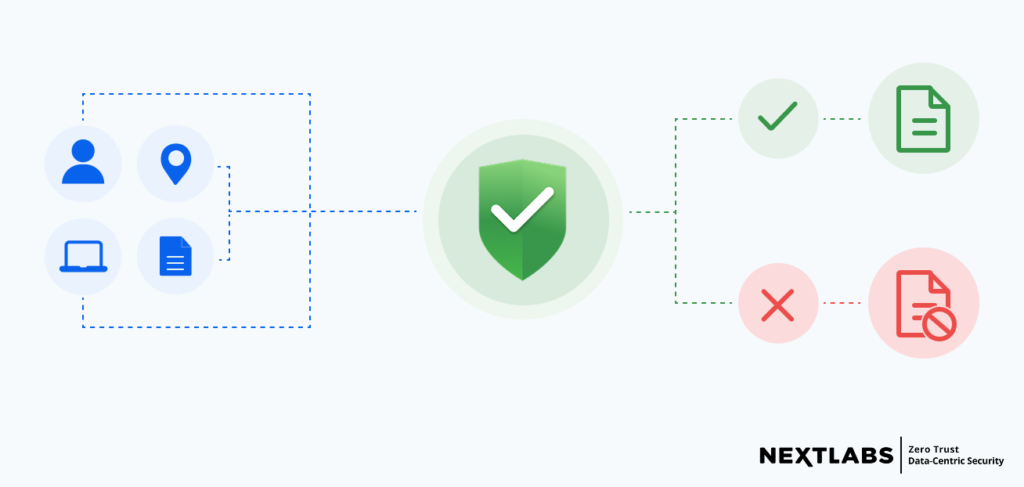
Securing AI outputs requires shifting focus from protecting systems to protecting the data itself. Drawing on Zero Trust and data-centric principles, this approach relies on controls that follow the output wherever it travels, continuously verifying access conditions rather than assuming trust based on a user’s network location or the system holding the file.
Enforcing Granular Access Control
Access decisions are based on multiple attributes – including a user’s role and responsibilities, business context, the sensitivity of the output, and the security of posture of the accessing device – rather than static roles or broad permissions. Attribute-Based Access Control (ABAC) applies these decisions dynamically, and when combined with DRM, they continue to govern usage after the output leaves its originating system.
Maintaining Audit Trails and Data Lineage
Detailed records link each output to the model and dataset the produced it, the requesting users, the policies applied, and any downstream sharing or modification. These records become particularly important once outputs move outside the AI environment, and they support explainability by tracing outputs back to their origin – an expectation increasingly held by regulators and internal governance teams.
Monitoring for Misuse and Anomalous Behavior
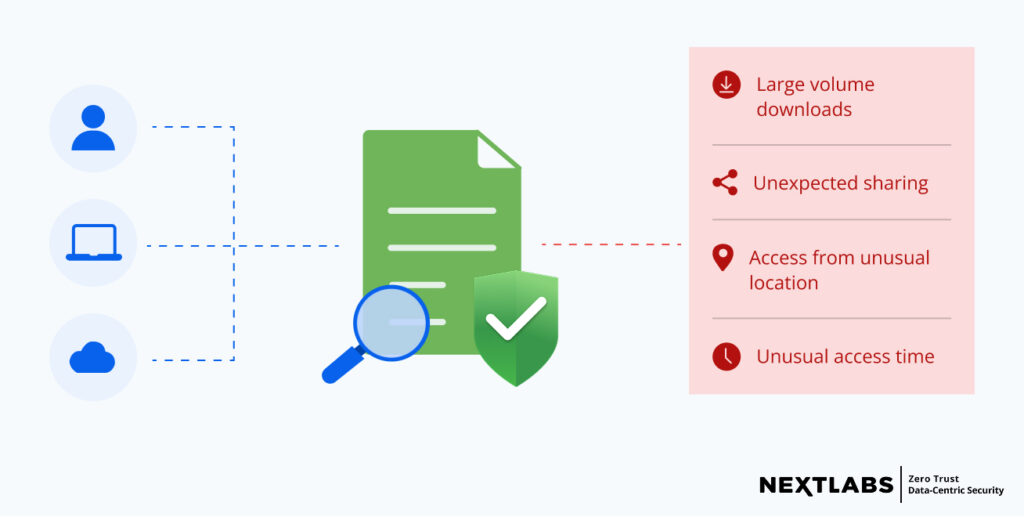
Continuous monitoring provides a proactive layer alongside DRM’s enforcement, helping organizations detect unusual patterns such as large-scale downloads or unexpected sharing that may indicate tampering or misuse. Primary enforcement and lifecycle control remain with DRM.
Protecting AI Outputs Wherever They Go
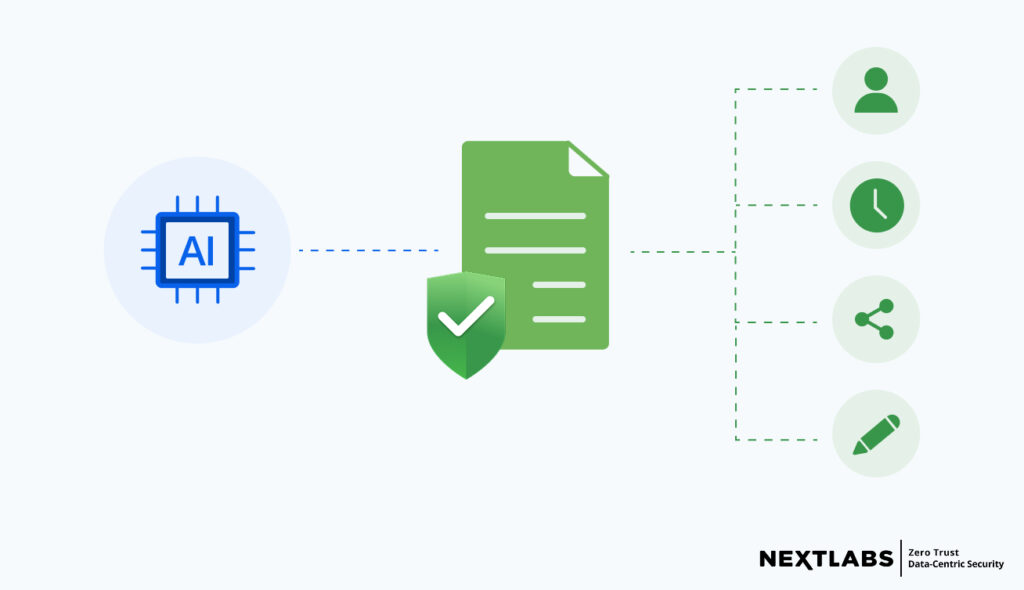
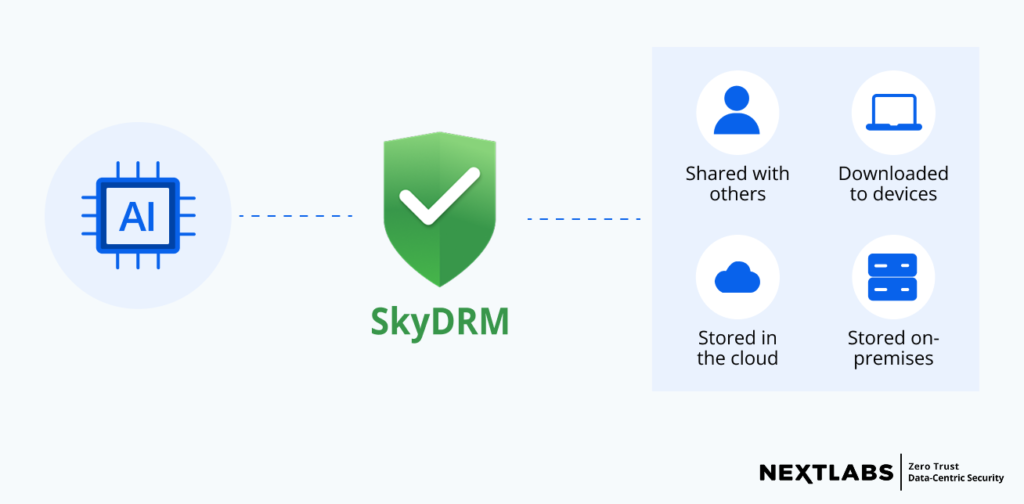
Each approach addresses a distinct dimension of protection – access, sensitivity, monitoring, and detection – but a gap remain once outputs move beyond the originating system. DRM addresses thus by binding protection directly to the output, so enforcement persists as it is downloaded, shared, and stored downstream. It functions most effectively as the persistent, data-bound layer within a broader defense-in-depth strategy.
How NextLabs SkyDRM Secures AI-Generated Outputs
Consider a financial service whose AI produces a risk report that passes from analysts to regional managers to external auditors – confidential data crossing boundaries at every handoff. SkyDRM is built for exactly this moment. It protects outputs automatically at the point of creation, so security doesn’t depend on users remembering to lock each file. It enforces dynamic, attribute-based policies that adapt to each access request instead of static user lists; and it keeps control after distribution – maintaining audit records, applying digital watermarks to trace leaks, and letting access rights be modified or revoked even for files already sent externally. Because protection is bound to the output itself, control doesn’t end at the perimeter.
Download the full White Paper
Explore how NextLabs helps organizations address NIST SP 800-53 access control requirements, enforce dynamic and attribute-based authorization, reduce insider risks, and strengthen security across complex federal and enterprise environments.