Home | Solutions | Trade Secret | Intellectual Property Protection
As the world becomes more interconnected, companies find themselves in increasingly distributed and collaborative supply chains. The myriad benefits of flexibility and efficiency come along with increased risks as valuable intellectual property (IP), product data, and technical know-how move beyond traditional organizational boundaries. While risks in processes and materials are widely discussed, the intangible yet intricate issue of IP protection gains more strategic importance and warrants more discussion. Digital IP is routinely replicated across enterprise systems, collaboration platforms, supplier environments, backups, and development workflos, increasing the potential for unauthorized access, misuse, or disclosure. Organizations that effectively protect company, customer, and supplier IP establish themselves as trusted partners capable of supporting complex global collaboration.
The Nextlabs whitepaper “Intellectual Property Protection” describes some of the key challenges to protecting IP within the collaborative supply chain, outlines ten real-world best practices for managing those risks, and describes the NextLabs’ solution for implementing those best practices.
IP Protection Challenges
A globalized supply chain and diversified workforce allow enterprises in various industries to enjoy better technology and work efficiency with lower cost and more flexibility. Various industries share these benefits, such as High Tech, Capital Equipment, Aerospace and Defense, Industrial Machinery, and Chemical, which also share the challenges of protecting IP within collaborative supply chains, as IP can be easily transformed, duplicated, and shared:
- Outsourced manufacturing: OEMs share a large amount of data when they outsource the manufacturing of components to contract manufacturers. OEMs need to ensure that only the appropriate level of IP with contract manufacturers, and contractors need to ensure IP is properly protected within their organizations.
- Global product development: When enterprises allocate components of product development in global locations, there is a need to address the associated compliance and information risk with increased complexity for managing different local regulatory compliance.
- Mobile workforce or mobile data: Remote and hybrid work is widely welcomed as it provides greater flexibility and productivity, but the mobile workflow extends company IP beyond traditional corporate boundaries. Even when protected by endpoint security controls, laptops, mobile devices, and removable media create additional risk through offline access, synchronization, unmanaged applications, credential compromise, and physical loss or theft.
- Collaborative technologies: Many collaborative technologies such as email, instant messaging, Microsoft SharePoint, extranet portals, and software-as-a-service (SaaS) applications make it easier to share information. While modern collaboration platforms provide strong security capabilities, organizations frequently struggle with permission sprawl, oversharing, unmanaged guest access, and inconsistent governance. These platforms often lack mandatory controls over information shared both internally and externally, making the boundary between authorized external collaboration and external data loss unclear.
- Structured data in enterprise systems: A significant share of IP resides outside files. Bills of materials, process recipes, part masters, formulations, and cost data are held as records in ERP, PLM, and MES systems and in the databases and data lakes behind them. Access to these systems is often granted at the role or module level, which allows users with legitimate access to one project’s records to view records belonging to others. Protecting this data requires controls at the record and field level rather than at application login alone.
- AI-assisted collaboration: Generative AI and AI-powered productivity tools introduce a new dimension of IP risks. Employees may inadvertently expose sensitive technical data, source code, product designs, or trade secrets when interacting with AI systems, which can summarize, transform, and generate content from large volumes of information. Organizations must establish governance policies that define approved AI services, permitted data types, monitoring requirements, and controls that prevent unauthorized disclosure of IP while enabling responsible AI adoption.
Whether information resides in documents, enterprise applications, collaboration platforms, or AI-powered tools, effective IP protection must follow data as it moves across applications, systems, users, and organizational boundaries.
IP Protection Best Practices
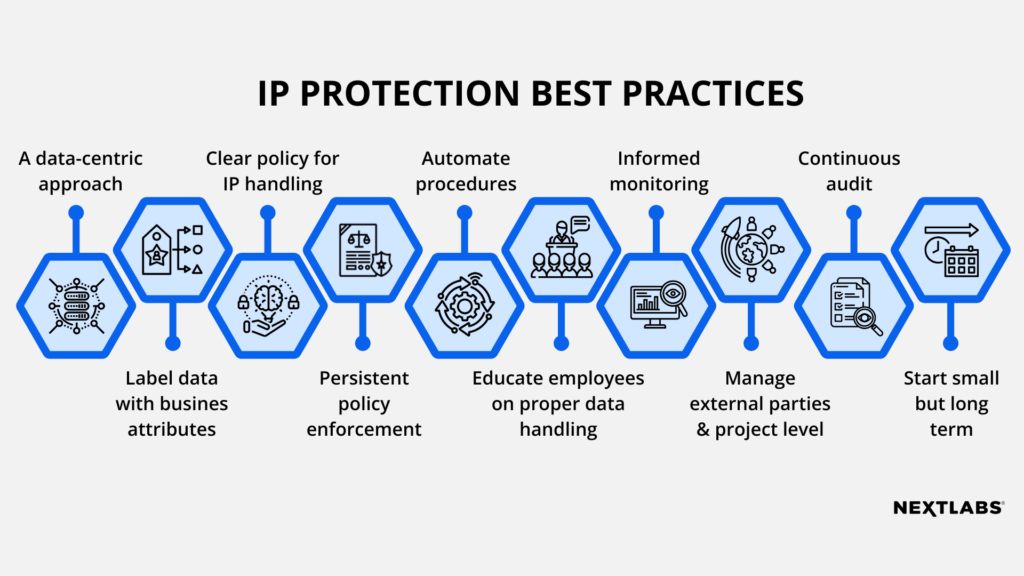
In the collaborative supply chain, organizations need to take a risk management approach to IP protection: identify risks, tackle the largest ones first, design controls (policies and procedures) to address those risks, implement and audit the effectiveness of these controls, and repeat as necessary.
Throughout this process, it is vital to take a data-centric approach, as data can easily be downloaded, transformed, copied, and shared. Thus, protection must span applications, servers, desktops, cloud services, AI-enabled tools, and communication channels.
To efficiently classify data and manage access accordingly, it is helpful to label data with business attributes, such as the type of data or document, the project it is for, and the organization it belongs to. These business attributes would change infrequently compared to classification based on data sensitivity, which are often non-prescriptive and can change several times over its lifecycle. This enables data classification to remain relatively constant and straightforward for end users to apply.
Based on these attributes, policies that are clear, simple, and easy-to-remember should be established to ensure that the appropriate protection is applied to IP as it is created, stored, and shared. These policies should be consistently enforced. Modern policy enforcement continuously evaluates user, device, application, data, and contextual attributes to determine appropriate access decisions in accordance with Zero Trust principles, applies consistently across enterprise applications, collaboration platforms, and approved AI services. IP protection procedures should be automated where possible, so that end users are not required to choose between productivity and compliance.
IP protection extends beyond technical transformation and requires systematic awareness within the organization and extended enterprise. It is crucial to educate employees about policy application and ensure the integration of IP protection into daily workflows. Equally important is to track and record the level of collaboration and information sharing with external partners to have visibility over the access, use, and sharing of sensitive IP. Once the controls are in place, organizations should continuously monitor and analyze critical data use, and audit the control mechanisms to reduce the risks of data breaches and regulatory incompliance in a cost-efficient manner.
Solution for IP Protection in the Collaborative Supply Chain
NextLabs provides a number of applications for both OEMs and contract manufacturers that help companies manage IP risk. Each application provides prebuilt controls (policies and procedures) and audit reports that can be automatically enforced by NextLabs Application Enforcer and NextLabs Data Protection. The products can support companies that are looking for a safer collaboration within global supply chains in the following aspects and more:
- IP Classification and Tagging: Tags can be automatically applied to documents as they are created, stored or shared based on identity, context, and content, or end users can be prompted to apply required tags as they save documents. Metadata and policy attributes can also be used to identify and govern information accessed through approved AI-enabled business applications.
- IP Activity Monitoring, Audit, and Reporting: User access, usage, storage, and sharing of IP data are automatically monitored. Prebuilt dashboards, charts, and reports highlight important trends and key compliance indicators, and behavioral analytics identify abnormal access patterns, potential insider threats, and unusual data movement, including activity occurring through approved AI-enabled applications.
- Project-Based Access and Document Control: Control access to IP across multiple applications or systems based on project assignments for employees, supply chain partners and customers. A single set of policies governs access to IP across file servers, document management systems, and collaboration sites. Access rights change automatically as individuals are assigned to or removed from projects.
- Project Information Barriers and Controlled Data Movement: Policy-based information barriers limit where project data can be stored and with whom it can be shared over email, instant messaging, or web meetings. When a user attempts to move project data outside these boundaries, the action can be alerted, warned, or blocked according to policy, with built-in remediation workflows that apply protection, log the event, or route the request for approval.
- Content-Aware Usage Control: Policies evaluate not only who is requesting access, but which application is making the request, what class of data is involved, and where the user and device are located, and permit or deny the action accordingly. Enforcement applies to local applications and continues when devices operate offline.
- Controlled External Distribution: Global policies ensure that IP is shared with external partners or customers using the appropriate channel with the right level of data security. Policies detect data transfer initiated over email, file transfer, or messaging and respond before it proceeds, applying persistent protection to the file or initiating a remediation workflow such as manager review or export license determination. The transfer and the response are logged, providing compliance teams with a record of what left the organization, to whom, and under what conditions.
- Protection that Travels with the File: Once IP is downloaded, emailed, or copied to a laptop, mobile device, or partner system, controls in the source application no longer apply. Protection attached to the file itself continues to govern who may open it and what they may do with it, regardless of device or network, and access can be changed or revoked after the file has been shared.
- IP Protection in Structured Data: Record- and field-level controls govern access to IP held in ERP, PLM, and MES systems and the databases behind them. Users see only the records associated with their projects, sensitive fields can be masked for users who do not require the underlying values, and create, update, and delete actions are governed by the same policies that control access.
- Just-in-Time Policy Education: When a policy applies, users are informed why, shown the approved alternative, and, where policy allows, given the option to proceed with protection applied automatically.
Download the full White Paper
Explore how organizations can protect valuable intellectual property, reduce risks across collaborative supply chains, maintain control over sensitive information, and apply best practices to prevent unauthorized access, sharing, and misuse.