

Automate & Prevent: Extending Detect and Respond for Proactive, Scalable Security
Overview
Detect and Respond (D&R) is a widely adopted cybersecurity model focused on identifying and mitigating threats after they have entered an organization’s environment. This approach relies on continuous monitoring, alerting, investigation, and remediation to limit the impact of security incidents. While D&R remains a critical component of modern security programs—particularly for detecting unknown or advanced threats—it is inherently reactive and resource-intensive.
As organizations face increasing attack volumes, alert fatigue, and expanding digital environments, traditional Detect and Respond strategies struggle to scale effectively. Security teams are often overwhelmed by manual triage, false positives, and repetitive response tasks, limiting their ability to focus on high-risk or novel attacks. These challenges are further compounded as enterprises adopt Zero Trust Architectures (ZTA), which require more granular, context-aware, and continuously enforced security controls.
To address these limitations, security leaders are extending Detect and Respond with proactive Automate and Prevent capabilities. This evolution shifts security operations from assuming breach to actively reducing the likelihood and impact of attacks before they occur—while preserving the strengths of rapid detection and response. This blog also covers the NextLabs approach along with the business benefits of adopting this cybersecurity model.
Business and Security Challenges
Organizations operating under a Detect and Respond–only model face several persistent challenges:
- A reactive security posture that allows known threats to repeatedly reach detection and response stages.
- High operational costs driven by manual investigation, remediation, and alert handling.
- Difficulty scaling security operations as users, applications, and data volumes grow.
- Increased risk of human error due to manual policy enforcement and response actions.
- Limited ability to enforce consistent security controls across diverse systems and workflows.
Traditional point solutions and perimeter-based controls are insufficient in addressing these challenges, particularly in environments where sensitive data moves freely across cloud platforms, enterprise applications, endpoints, and external partners.
Extending Detect and Respond with Automate and Prevent
Automate and Prevent enhances the traditional Detect and Respond paradigm by embedding security controls earlier in the lifecycle and enforcing them automatically. Prevention focuses on stopping attackers before they gain a foothold, while automation ensures that security policies are applied consistently, accurately, and at scale.
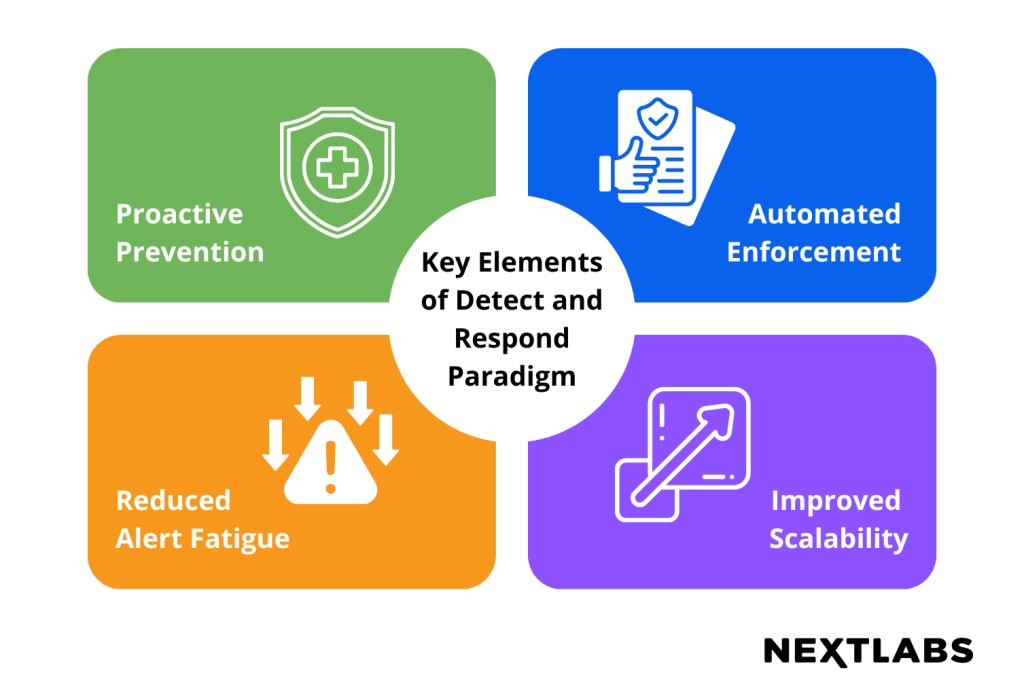
Key elements of this extended paradigm include:
- Proactive prevention through least-privilege access, data masking, segmentation, and policy-based controls.
- Automated enforcement of security and compliance policies to reduce incident volume and operational overhead.
- Reduced alert fatigue by stopping known threats before detection tools are triggered.
- Improved scalability through automated workflows that adapt to changing environments without additional staffing.
Together, these capabilities allow security teams to concentrate their expertise on fewer, higher-impact incidents while improving overall resilience.
An Evolved Security Model
The integration of Automate and Prevent with Detect and Respond creates a layered, continuous security lifecycle that protects organizations before, during, and after an attack. This evolved model emphasizes preemptive defense and intelligent automation while retaining rapid detection and effective response for threats that bypass preventive controls.
By organizing security operations across prevention, automation, detection, and response, organizations can maximize coverage, reduce time to resolution, and build a more mature and scalable security posture aligned with Zero Trust principles.
The NextLabs Approach
NextLabs implements Automate and Prevent as part of its Zero Trust Data-Centric Security framework, extending Detect and Respond with proactive data protection and automated security operations.
NextLabs focuses on protecting business-critical data wherever it resides—at rest, in use, and in motion—by enforcing attribute-based, least-privilege access controls. Sensitive data is dynamically masked, filtered, or restricted based on user identity, data classification, and business context, reducing the risk of unauthorized access and data leakage.
Automation further strengthens operations by streamlining policy enforcement, role provisioning, compliance procedures, and audit reporting. By eliminating manual processes and embedding security directly into workflows, NextLabs enables consistent enforcement while minimizing disruption to legitimate business activities.
Business Benefits
By extending Detect and Respond with Automate and Prevent, organizations gain measurable benefits:
- Reduced risk through fewer successful attacks and minimized exposure of sensitive data.
- Greater efficiency by automating repetitive security and compliance tasks.
- Improved scalability as security workflows adapt automatically to growth and change.
- Increased consistency and accuracy in policy enforcement across the enterprise.
- Stronger long-term resilience through proactive, data-centric Zero Trust security.
Ultimately, this approach enables organizations to move beyond reactive defense and build a proactive, automated security model that protects critical data, supports compliance, and scales with the business.
To comment on this post
Login to NextLabs Community
NextLabs seeks to provide helpful resources and easy to digest information on data-centric security related topics. To discuss and share insights on this resource with peers in the data security field, join the NextLabs community.
Don't have a NextLabs ID? Create an account.