

Zero trust principles are the fundamental guidelines that define how organizations implement a Zero Trust security model. They emphasize that no user, device, or system should be trusted by default, and every access request must be continuously verified. These principles include enforcing strict access controls, applying the principle of least privilege, protecting sensitive data and critical assets, segmenting networks into secure zones, assuming that breaches are possible or inevitable, and continuously monitoring and validating all users, devices, and connections. Together, they form the foundation of a zero trust security model, helping organizations reduce risk, prevent lateral movement, and maintain a resilient security posture.
Understanding Zero Trust Principles
Zero trust principles shift the security mindset from implicit trust to continuous verification. Every user identity, device, and connection is treated as untrusted by default. These principles focus on protecting data, controlling access, and enforcing verification, rather than relying on a fixed network perimeter or static security models.
Central concepts include verifying explicitly, enforcing least privilege access, implementing continuous monitoring, and segmenting networks into secure zones.
The following key practices, including verifying every user and device, enforcing least privilege access, continuously monitoring activity, microsegmenting networks, protecting critical data, assuming breaches, and applying adaptive trust, embody the core Zero Trust principles.
Verifying Every User and Device
A key zero trust principle is that no entity should be trusted by default. Every access request must undergo authentication and verification.
- Strict access controls define which users or devices can gain access to specific resources.
- Multi-factor authentication (MFA) ensures secure verification of user identity.
- Zero trust network access (ZTNA) ensures users and devices can only reach the resources they are authorized for, rather than the entire network.
By enforcing these measures, security teams can prevent unauthorized access to critical assets and sensitive data.
Principle of Least Privilege
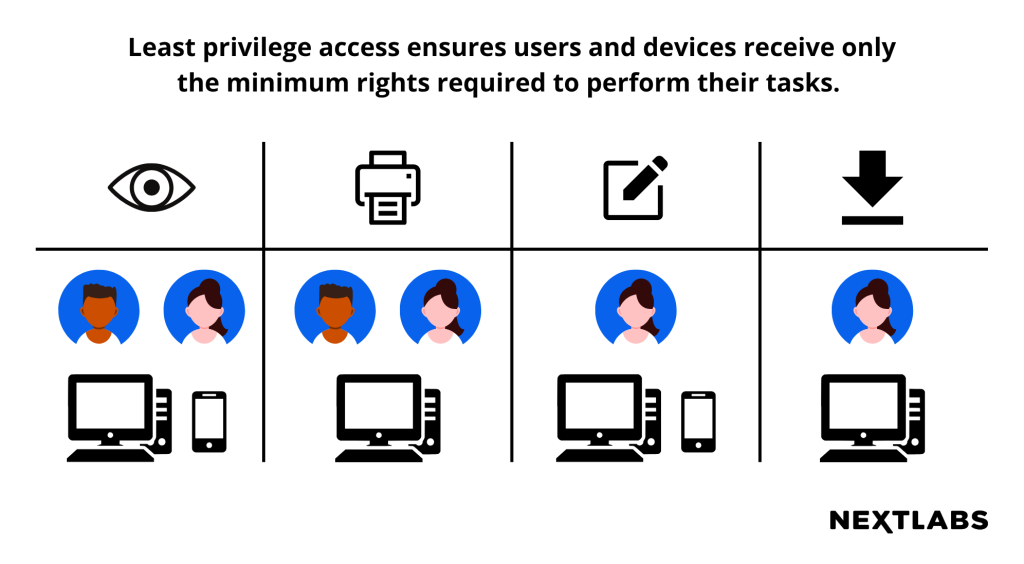
- Reduces potential damage if credentials are compromised.
- Prevents lateral movement across vulnerable network systems.
- Supports granular access control and enforcement of security policies.
Combining least privilege access with continuous verification ensures that access remains strictly controlled.
Continuous Verification
Continuous verification requires ongoing assessments of all users and devices:
- Monitoring network traffic and user behavior to detect anomalies.
- Performing continuous validation of identity and device posture.
- Dynamically adjusting trust based on real-time conditions.
This principle strengthens the zero trust security model, ensuring that trust is never assumed.
Microsegmentation and Secure Zones
Microsegmentation divides networks into secure zones, isolating sensitive systems.
- Prevents lateral movement within the network.
- Limits exposure if a single zone is compromised.
- Supports zero trust network access (ZTNA), granting access only to verified users and devices.
By applying microsegmentation, organizations implement zero trust principles that contain threats and limit potential damage.
Protecting Data and Critical Assets
A data-centric approach is central to zero trust security.
- Access is based on the sensitivity of critical assets and sensitive data.
- Policies prevent unauthorized users or devices from accessing protected resources.
- Encryption and strict security measures safeguard data at rest and in transit.
This principle ensures regulatory compliance and reduces the risk of data exposure, even in complex cloud environments.
Assuming Breach
Zero trust principles operate under the assumption that breaches are possible, or even inevitable.
- Segmentation and secure zones isolate compromised systems.
- Access management minimizes damage through least privilege access.
- Supports proactive threat mitigation for security teams.
Assuming breach encourages organizations to focus on containment, protecting critical assets while limiting risk across the entire network.
Adaptive and Contextual Trust
Zero trust principles are dynamic rather than static.
- Access decisions are continuously updated based on user identity, device posture, and network traffic.
- Incorporates threat detection and ongoing risk assessment.
- Adjusts the security model and architecture as conditions change.
This ensures security remains effective across hybrid, cloud, and corporate environments.
Collaboration and Security Oversight
Effective zero trust security models rely on close collaboration between technology systems and security teams.
- Monitoring users and devices across the network in real time.
- Detecting anomalies and enforcing security policies consistently.
- Integrating automated security tools to manage access requests and verify compliance.
Coordination ensures trust principles are actionable and measurable, not just theoretical.
Data-Centric Trust
Protecting sensitive data is at the heart of zero trust principles.
- Access control is tied to the sensitivity of the information, not the location of the user.
- Prevents unauthorized cloud usage and protects critical assets.
- Supports regulatory compliance and mitigates risks associated with unauthorized cloud services.
Data-centric trust works in harmony with zero trust network access and least privilege access, creating a comprehensive trust security model.
Automation and Policy Enforcement
Automation ensures that zero trust principles scale effectively:
- Automates access management and policy enforcement.
- Supporting continuous monitoring across all users and devices.
- Reducing human error while maintaining strong security posture.
This ensures trust principles are consistently applied across the organization.
Continuous Improvement
Zero trust principles are not static,; they evolve with the threat landscape.
- Regular updates to security policies maintain alignment with new threats.
- Enhancements to security controls adapt to changing network traffic patterns.
- Continuous review ensures the trust architecture remains effective.
By continuously applying these principles, organizations can maintain resilience against modern cyber threats.
Key Zero Trust Principles in Practice
Implementing a Zero Trust Architecture begins with understanding and applying core Zero Trust principles aligned with NIST SP 800-53 controls. These principles guide organizations to never trust by default, enforce least privilege access, continuously verify users and devices, and protect sensitive data at all times. By focusing on these principles, security teams can reduce risk, prevent lateral movement, and ensure that access to critical resources is dynamically controlled based on context, user identity, and data sensitivity. Integrating these principles with NIST 800-53 strengthens a data-centric security model that is adaptive, resilient, and aligned with modern enterprise requirements.
Conclusion
Zero trust principles provide a structured approach to cybersecurity. They emphasize continuous verification, least privilege access, and data-centric trust, all enforced through strict access controls and zero trust network access. By following these principles, organizations can protect critical assets, safeguard sensitive data, prevent lateral movement, and strengthen their zero-trust security model.
Adopting zero trust principles shifts security from reactive to proactive, ensuring a “never trust, always verify” approach that is essential for resilient, modern IT environments.
To comment on this post
Login to NextLabs Community
NextLabs seeks to provide helpful resources and easy to digest information on data-centric security related topics. To discuss and share insights on this resource with peers in the data security field, join the NextLabs community.
Don't have a NextLabs ID? Create an account.